
Ontario homeowners are expected to get rebates by year's end for overpaying on hydro bills last year but consumers won't be getting back all they deserve. Ontario Energy Minister Donna Cansfield said consumers will get an average rebate on their hydro bill of about $60, with some homeowners receiving as much as $95 and an average small business getting $150. The rebates are owed because electricity prices last year were lower than the price estimated in advance by the province. There is a large descrepincy between the Electricity Consumer Price Protection Fund of $495 million that Ontario homeowners are set to share and the reported figure of $528 million that the government listed on their books. When asked by reporters, Ontario Energy Minister Donna Cansfield had difficulty explaining this or where any accumulated interest on the price protection fund had gone instead she passed the buck to Ronald Kwan of the Finance Ministry.
From:Canadian Press' Steve Erwin
Ronald Kwan of the Finance Ministry said the $528 million was an "estimate" of what Ontario Electricity Financial Corp. expected to receive. When actual cash receipts reached the government, Kwan said the surplus reached $565 million -- $70 million more than the amount being returned to consumers. But Kwan said that $70 million did not come from electricity users under the government's interim pricing plan, but instead came from consumers who bought electricity on the spot market -- typically large industrial users. That $70 million was used to pay off Ontario's hydro debt, which was built up over the years mostly due to expensive cost overruns at nuclear facilities. Reducing that so-called stranded debt should reduce the amount of time customers have to pay a debt-retirement charge on their bills, said Richard Jennings of the Ministry of Energy.
Where is this money? Burried in a very large government backyard? or maybe they collected all this money and stuck it in one of their low interest Canada Savings Bonds. Thank you Uncle Scrooge McGuinty for the early Christmas gift I'll enjoy the new energy saving can opener I'll buy with my $60.
Later,
Kenaz
Thursday, October 27, 2005


Emilly Carr

Emily Carr was born in Victoria, British Columbia on December 13, 1871 and past away on March 2, 1945. Her rebellious nature dominated her attitude from a young age, and likely helped shape her independence.
She lived most of her life on Vancouver Island but did live in San Francisco for three years, five years in England and one year in France. Each of these experiences had a profound effect on her development.
She moved to San Francisco because of the lack of art schools, art collections and professional artists in the Victoria area that she could learn from. Eventually a lack of finances forced her to return. After the California School of Design in San Francisco, she returned to Victoria to teach art classes to children. In 1899, Carr took up studies at the Westminster School of Art in London. And also attended sketching classes in Cornwall. In 1910, she enrolled in the Academie Colarossi in Paris. It was here that she would break away from her more traditional teachings. Unfortunately, her work was not received well when she returned to Vancouver. British Columbians were unwilling to deviate from the English landscape tradition.
In 1913, Carr needed to supplement her income by raising livestock, growing vegetables and making pottery. But by 1927, she was invited to Ottawa for an exhibition and met Lawren Harris, who had a profound effect on her and her work. The confidence and encouragement shown by the Group of Seven rekindled her spirit and motivated her to return to painting.
The two driving themes of her work were the unique and vanishing Native culture and a powerful coastal nature. Her first trip to Native villages was in 1898. Between her fifty-sixth and seventy-first years, her paintings of dark forests, Native carvings, trees, wild storms and infinite skies reflected her Pacific Coast experience. Earlier in her life, she went through a number of other phases. During one phase in her career, she painted in a French postimpressionist and Fauve School manner and in another showed links to Cubism. Her work suggested connections to van Gogh and German Expressionism.

Emily Carr, Totem Forest, (c. 1930), oil, 128.6 x 92 cm, Vancouver Art Gallery, Vancouver, BC.
The sketching of totem poles, which were often found in remote locations subject to harsh weather conditions, is seen in many of her paintings. However, by 1931 she left the Native theme. Her change of focus was likely due to Lawren Harris and Mark Tobey, who both advised her to create art from within herself. For Carr, she had intuitively grasped the Native's relationship to the natural and spiritual world and his environment. By gaining this understanding, she decided to move on to new challenges.

Emily Carr, Scorned as Timber, Beloved of the Sky (1935), oil, 112 x 68.9 cm, Vancouver Art Gallery, Vancouver, BC.
A chronological history of paintings is difficult, since she stopped dating her paintings after 1930. Historians are left to evaluate the style or geographic location and attempt to correlate it with a year.
The 1930's saw a rebirth of both her writing and painting. But by 1937, her confinement to bed limited her painting activities.
From a prim and proper orthodox religious household, she asserted her rebellious nature early in life. She often escaped the rules and rigidity of her childhood household to explore nature.
Encouragement from the Group of Seven, in the late 1920's, was important in her return to painting after several unproductive years. While there are similarities in style with the Group of Seven, Emily Carr was very individualistic and departed from the techniques of the Group of Seven by never using the oil field sketch. Instead she devised a unique process of oil paint used with gasoline. Her innovative ideas in 1932 were out of necessity, according to. Conventional artist's materials were expensive. Instead she used ordinary white house paint and cheap manila paper, which she bought in bulk and was easy to carry.

Emily Carr Totem Poles, Kitseukla, 1912 oil on canvas
She had ill health through much of her life. While in France in 1910, she had several intervals of poor health. In 1902, she became seriously ill and was in the East Anglia sanatorium in Suffolk between 1903-4. In 1937, she had her first heart attack, which was followed by another in 1939, a stroke in 1940, and another heart attack in 1942. In 1945, she had her final and fatal heart attack.
In her latter years, Emily Carr stated: "Spring was young, I over seventy. With Spring all about me I sat sketching in the clearing … Seventy years had maimed me, loggers had maimed the clearing … but I got immense delight in just being there, in the quiet wood, the longing was too terrific to subdue, and I felt better."
Carr as a very complex person, who was both brave and spiritual, and yet overweight, irritable and socially insecure. Simply, we need to recognize that Carr was imperfect and struggled and except it.
In conclusion, Emily Carr grew out of a very strict upbringing with a defiant and rebellious nature that would shape her work throughout her life. Her fascination with the Pacific Coast and the spirituality of Native peoples was a profound influence on her work during certain phases of her career. She traveled abroad in order to hone her painting skills but still returned to British Columbia.
The Group of Seven were certainly a profound influence on her work and life, although she still remained individualistic. While her styles changed over time, she managed to create work that will be remembered and cherished by people for many years to come.

Emily Carr The Red Cedar, c1931-33 oil on canvas
Later,
Kenaz
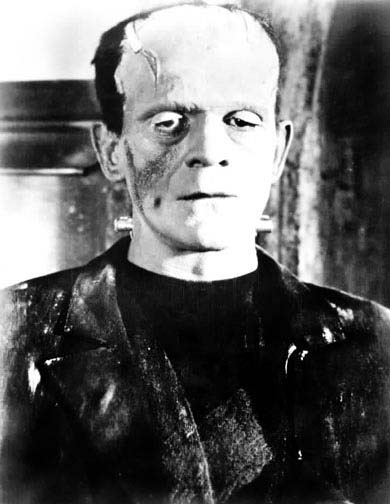
Classic Horror Ledgends:Boris Karloff
Hollywood's most successful boogeyman, a gaunt, bow legged actor whose menacing mien scared the bejesus out of several generations of film fans, was in fact one of the movie colony's most popular citizens, and by all accounts a gentle, sensitive, highly cultured man. The scion of a family of British diplomats, he eschewed foreign-service work in favor of acting, emigrating to Canada and eventually touring with small companies all over North America. He made his screen debut as an extra in The Dumb Girl of Portici (1916), but didn't approach film work in earnest until 1919, when he appeared in the Douglas Fairbanks starrer His Majesty, the American
By now billed as Boris Karloff, he played supporting roles-mostly heavies- in dozens of minor features and serials throughout the 1920s, including The Hope Diamond Mystery (1921), Nan of the North (1922), Dynamite Dan (1924),Lady Robin Hood (1925),Eagle of the Sea (1926), Tarzan and the Golden Lion (1927), King of the Kongo (1929), and The Fatal Warning (1929). He appeared in a few A movies, too, including 1926's Old Ironsides and 1927's Two Arabian Knights Although Karloff spoke in soft, cultured tones, he affected a harsh, guttural voice in his early sound films, which included The Unholy Night (1929), The Sea Bat (1930), Public Defender, Smart Money, Business and Pleasure and The Mad Genius (all 1931).
Karloff, who had resigned himself to working as a character actor, was more than happy to assume a role originally offered to Dracula star Bela Lugosi, who refused it on the ground that he would be unrecognizable under heavy makeup in a part with no dialogue. So Karloff played the lumbering monster in Frankenstein (1931), a physically demanding assignment that made him a star. Makeup artist Jack Pierce and director James Whale helped him flesh out the characterization, which enabled him to steal the picture from top-billed Colin Clive.
Karloff spent the next several years alternating horror films with more prestigious major-studio productions. He scared moviegoers witless with his starring turns in The Old Dark House, The Mummy, The Mask of Fu Manchu (all 1932), The Ghoul (1933), Bride of Frankenstein, The Black Room (both 1935), and The Walking Dead (1936), in addition to three films that teamed him with his partner-in-menace Lugosi:The Black Cat (1934), The Raven (1935), and The Invisible Ray (1936). He also took colorful supporting roles, playing a sleazy reporter in Five Star Final (1931), a gangster in Scarface (1932), an anti-Semitic nobleman in House of Rothschild a religious fanatic in The Lost Patrol (both 1934), a kindly inventor in Night Key and a suspicious opera singer in Charlie Chan at the Opera (both 1937).
As the horror cycle waned in the late 1930s, Karloff found himself mired in undistinguished B films, including West of Shanghai (1937), The Invisible Menace (1938), and British Intelligence (1940). He starred as a low-rent Charlie Chan in several "Mr. Wong" mysteries for Monogram, the best of which was The Mystery of Mr. Wong (1939). Back at Universal, he played the Frankenstein monster for a third and final time in Son of Frankenstein and then supported Basil Rathbone in an elaborate costume drama with horrific overtones, Tower of London (both 1939).
By now typecast as a movie menace, Karloff worked during the 1940s almost exclusively in B horror films and thrillers, including The Man With Nine Lives (1939), Before I Hang, You'll Find Out (a horror spoof that teamed him with Lugosi and Peter Lorre), The Ape (all 1940), The Devil Commands (1941), The Boogie Man Will Get You (1942), The Climax (a cut above his usual 1940s' vehicles), House of Frankenstein (both 1944, this time as mad scientist rather than monster), and Dick Tracy Meets Gruesome (1947). The "murder man" (as he was sometimes billed) spoofed his screen persona in the 1941 stage production of "Arsenic and Old Lace," enjoying a lengthy Broadway run as that play's menacing madman (but, unfortunately, missing out on repeating the role in the movie). He was well served by RKO producer Val Lewton, whose stylish, low-budget chillers ranked head and shoulders above the usual run of horror films; his assignments in Lewton's The Body Snatcher (1945, which again teamed him with Lugosi), Isle of the Dead (also 1945), and Bedlam (1946) were among his most memorable of the decade.
Karloff got a few nice supporting roles in A films of the immediate post WW2 era, including The Secret Life of Walter Mitty (1947), Unconquered (1948, as an Indian), and Tap Roots (1949), but by the 1950s he was working almost exclusively in dreary, low-budget horrors (in both senses of that word) that traded on the success of his earlier films.Abbott and Costello Meet the Killer, Boris Karloff (1949), The Strange Door (1951), The Black Castle (1952), Abbott and Costello Meet Dr. Jekyll and Mr. Hyde (1953), Voodoo Island (1957), The Haunted Strangler andFrankenstein-1970 (both 1958) saw an aging Karloff going through the motions with obvious professionalism but little enthusiasm.
He fared better on Broadway during the 1950s, playing Captain Hook opposite Jean Arthur as Peter Pan, costarring with Julie Harris in "The Lark," and participating in a number of live TV plays as well. He starred in the filmed TV series "Colonel March of Scotland Yard" (1957-58), and hosted "Thriller" (1960-62) in addition to guesting in dozens of dramatic series, anthologies, sitcoms, and variety shows throughout the 1950s and 1960s.
Producer Roger Corman used Karloff in several of his colorful, all-star horror films and spoofs of the 1960s, including The Raven, The Terror (both 1963, built entirely around an unfulfilled three-day commitment Karloff owed Corman), and The Comedy of Terrors (1964). Bravely, the aging master subjected himself to the indignities of Bikini Beach (1964) and The Ghost in the Invisible Bikini (1966), in addition to a quartet of Mexican-made horror cheapies, all of which were released posthumously. Karloff's swan song was Targets (1968), a modestly budgeted thriller directed by Peter Bogdanovich, which had the star playing an elderly horror-film actor. It was an offbeat role that Karloff obviously relished, and he delivered his best performance in years. Since the early 1960s he'd been afflicted with respiratory problems, and frequently retired to a wheelchair and an oxygen mask between scenes. He died in 1969, still a much beloved screen star.
Personal Quotes:
On whether or not he resented being typed as a "horror star": "One always hears of actors complaining of being typed - if he's young, he's typed as a juvenile; if he's handsome, he's typed as a leading man. I was lucky. Whereas bootmakers have to spend millions to establish a trademark, I was handed a trademark free of charge. When an actor gets in a position to select his own roles, he's in big trouble, for he never knows what he can do best. I'm sure I'd be damn good as little Lord Fauntleroy, but who would pay ten cents to see it?"
Trivia:
Was one of the founding Members of the Screen Actor's Guild. His daughter recounts that, due to the Hollywood Studio System's distrust of unions, one of her earliest memories of her father was that he always had carried a roll of dimes in his pocket. This was because he always had to use payphones when dealing with union business, since he knew his home phone had been tapped.
Refused to reprise his role as the Frankenstein Monster in Bud Abbott Lou Costello Meet Frankenstein (1948), because he felt spoofs wouldn't sell to the audience.
Appeared in 80 films before his breakthrough role in Frankenstein (1931).
He would mark his lines in the script. Jack Nicholson saw this and adopted the procedure himself.
In contrast to the image he presented in most of his films, the private Karloff was, by every account, a quiet, bookish man off- screen. A true gentleman, he had many friends, both in and out of show business, and he was particularly fond of children. For the latter, among other things, he recorded many successful albums of children's stories.

Later,
Kenaz
By now billed as Boris Karloff, he played supporting roles-mostly heavies- in dozens of minor features and serials throughout the 1920s, including The Hope Diamond Mystery (1921), Nan of the North (1922), Dynamite Dan (1924),Lady Robin Hood (1925),Eagle of the Sea (1926), Tarzan and the Golden Lion (1927), King of the Kongo (1929), and The Fatal Warning (1929). He appeared in a few A movies, too, including 1926's Old Ironsides and 1927's Two Arabian Knights Although Karloff spoke in soft, cultured tones, he affected a harsh, guttural voice in his early sound films, which included The Unholy Night (1929), The Sea Bat (1930), Public Defender, Smart Money, Business and Pleasure and The Mad Genius (all 1931).
Karloff, who had resigned himself to working as a character actor, was more than happy to assume a role originally offered to Dracula star Bela Lugosi, who refused it on the ground that he would be unrecognizable under heavy makeup in a part with no dialogue. So Karloff played the lumbering monster in Frankenstein (1931), a physically demanding assignment that made him a star. Makeup artist Jack Pierce and director James Whale helped him flesh out the characterization, which enabled him to steal the picture from top-billed Colin Clive.
Karloff spent the next several years alternating horror films with more prestigious major-studio productions. He scared moviegoers witless with his starring turns in The Old Dark House, The Mummy, The Mask of Fu Manchu (all 1932), The Ghoul (1933), Bride of Frankenstein, The Black Room (both 1935), and The Walking Dead (1936), in addition to three films that teamed him with his partner-in-menace Lugosi:The Black Cat (1934), The Raven (1935), and The Invisible Ray (1936). He also took colorful supporting roles, playing a sleazy reporter in Five Star Final (1931), a gangster in Scarface (1932), an anti-Semitic nobleman in House of Rothschild a religious fanatic in The Lost Patrol (both 1934), a kindly inventor in Night Key and a suspicious opera singer in Charlie Chan at the Opera (both 1937).
As the horror cycle waned in the late 1930s, Karloff found himself mired in undistinguished B films, including West of Shanghai (1937), The Invisible Menace (1938), and British Intelligence (1940). He starred as a low-rent Charlie Chan in several "Mr. Wong" mysteries for Monogram, the best of which was The Mystery of Mr. Wong (1939). Back at Universal, he played the Frankenstein monster for a third and final time in Son of Frankenstein and then supported Basil Rathbone in an elaborate costume drama with horrific overtones, Tower of London (both 1939).
By now typecast as a movie menace, Karloff worked during the 1940s almost exclusively in B horror films and thrillers, including The Man With Nine Lives (1939), Before I Hang, You'll Find Out (a horror spoof that teamed him with Lugosi and Peter Lorre), The Ape (all 1940), The Devil Commands (1941), The Boogie Man Will Get You (1942), The Climax (a cut above his usual 1940s' vehicles), House of Frankenstein (both 1944, this time as mad scientist rather than monster), and Dick Tracy Meets Gruesome (1947). The "murder man" (as he was sometimes billed) spoofed his screen persona in the 1941 stage production of "Arsenic and Old Lace," enjoying a lengthy Broadway run as that play's menacing madman (but, unfortunately, missing out on repeating the role in the movie). He was well served by RKO producer Val Lewton, whose stylish, low-budget chillers ranked head and shoulders above the usual run of horror films; his assignments in Lewton's The Body Snatcher (1945, which again teamed him with Lugosi), Isle of the Dead (also 1945), and Bedlam (1946) were among his most memorable of the decade.
Karloff got a few nice supporting roles in A films of the immediate post WW2 era, including The Secret Life of Walter Mitty (1947), Unconquered (1948, as an Indian), and Tap Roots (1949), but by the 1950s he was working almost exclusively in dreary, low-budget horrors (in both senses of that word) that traded on the success of his earlier films.Abbott and Costello Meet the Killer, Boris Karloff (1949), The Strange Door (1951), The Black Castle (1952), Abbott and Costello Meet Dr. Jekyll and Mr. Hyde (1953), Voodoo Island (1957), The Haunted Strangler andFrankenstein-1970 (both 1958) saw an aging Karloff going through the motions with obvious professionalism but little enthusiasm.
He fared better on Broadway during the 1950s, playing Captain Hook opposite Jean Arthur as Peter Pan, costarring with Julie Harris in "The Lark," and participating in a number of live TV plays as well. He starred in the filmed TV series "Colonel March of Scotland Yard" (1957-58), and hosted "Thriller" (1960-62) in addition to guesting in dozens of dramatic series, anthologies, sitcoms, and variety shows throughout the 1950s and 1960s.
Producer Roger Corman used Karloff in several of his colorful, all-star horror films and spoofs of the 1960s, including The Raven, The Terror (both 1963, built entirely around an unfulfilled three-day commitment Karloff owed Corman), and The Comedy of Terrors (1964). Bravely, the aging master subjected himself to the indignities of Bikini Beach (1964) and The Ghost in the Invisible Bikini (1966), in addition to a quartet of Mexican-made horror cheapies, all of which were released posthumously. Karloff's swan song was Targets (1968), a modestly budgeted thriller directed by Peter Bogdanovich, which had the star playing an elderly horror-film actor. It was an offbeat role that Karloff obviously relished, and he delivered his best performance in years. Since the early 1960s he'd been afflicted with respiratory problems, and frequently retired to a wheelchair and an oxygen mask between scenes. He died in 1969, still a much beloved screen star.
Personal Quotes:
On whether or not he resented being typed as a "horror star": "One always hears of actors complaining of being typed - if he's young, he's typed as a juvenile; if he's handsome, he's typed as a leading man. I was lucky. Whereas bootmakers have to spend millions to establish a trademark, I was handed a trademark free of charge. When an actor gets in a position to select his own roles, he's in big trouble, for he never knows what he can do best. I'm sure I'd be damn good as little Lord Fauntleroy, but who would pay ten cents to see it?"
Trivia:
Was one of the founding Members of the Screen Actor's Guild. His daughter recounts that, due to the Hollywood Studio System's distrust of unions, one of her earliest memories of her father was that he always had carried a roll of dimes in his pocket. This was because he always had to use payphones when dealing with union business, since he knew his home phone had been tapped.
Refused to reprise his role as the Frankenstein Monster in Bud Abbott Lou Costello Meet Frankenstein (1948), because he felt spoofs wouldn't sell to the audience.
Appeared in 80 films before his breakthrough role in Frankenstein (1931).
He would mark his lines in the script. Jack Nicholson saw this and adopted the procedure himself.
In contrast to the image he presented in most of his films, the private Karloff was, by every account, a quiet, bookish man off- screen. A true gentleman, he had many friends, both in and out of show business, and he was particularly fond of children. For the latter, among other things, he recorded many successful albums of children's stories.
Later,
Kenaz
Subscribe to:
Posts (Atom)