An opening of one's knowledge,capabilities, vision and guidance. The Kenaz is about creating a relationship,learning and allowing room for interpretation. When you are in the darkness,an opening with light is the best and most gracious thing to have bestowed upon you. This is a great time for putting energies into new opportunities. Come share my world as I see it.

Monday, April 17, 2006

Rune Reading For The Period Of April 17-April 23,2006

Introduction to Rune Readings

Rune readings are arrangements of the 24 runes (letters) of the old Futhark alphabet. The layout of the runes is known as a spread, and determines what each rune refers to. For example, in the Three Norns spread, the first rune represents the past, the second the present, and the third the future.

Sets: In addition to each rune having a meaning, the material in which the runes are carved can color the reading. Most people consistently use runes made of ceramic, stone, or wood. In order to broaden your experience, we offer readings with Gold Runes (for questions about business, career, and property), Jade Runes (for questions about love, friendship, and relationships), Ice Runes (for questions about struggle, conflict, and achievement), Spirit Runes (for questions about mysticism, spirituality, and religion), and Stone Runes (for questions about the natural world and things beyond human control).

The question will remain the same: "Will this week be a successful one?"

Rune Alphabet
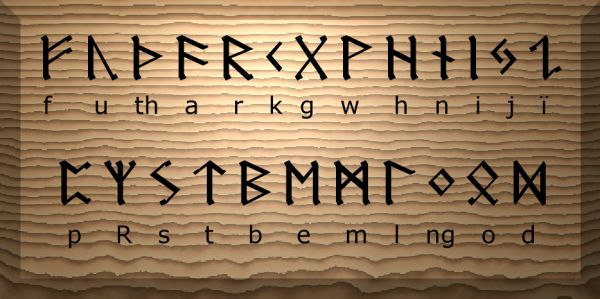


Spread:Cross(in order of reading)
The Cross spread is used to plot the arc of your life and the forces acting on it. It is the most popular spread, giving a very complete view of the situation. Ice Runes are most commonly used for questions about struggle, conflict, and achievement.


Here is the Reading Using the Ice Set.

1.
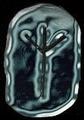

The left rune represents an important element of the past. Algiz can be easily recognized as the antlers of the elk that it represents. The elk can represent victory, but is much more appropriately associated with the thrill of the hunt itself. This rune therefore can portend vigor and success in active endeavors. Also, this rune seems symbolic of a hand with outstretched fingers - a protective hand. This hand may suggest that you will be shielded from things negative - the problems still exist, you are spared the brunt of their force.

2.
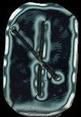

The middle rune represents a deciding element of the present. Nyd is frequently seen as a powerfully negative rune. You have drawn the rune reversed, which will lessen some of its effects. Generally Nyd represents loss, sorrow, and a hard journey with lessons learned. Nyd reversed here might be cautioning that the lessons might go unheeded representing repeated mistakes. The rune here might also be representing a minor loss or a nearly avoided catastrophe. Be careful, things are tricky and require strong attentiveness.

3.
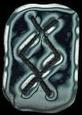

The right rune represents the critical element of the future, at the core of the final outcome. Inguz is the rune of completion and fertility. The presence of this rune suggests that tasks which have been initiated will come to fruition. This rune is associated with Ing and Frey, it is this connection that explains its connotations of both fertility and sexuality. The variant of this rune shown here is reminiscent of the twin strands of life, and of the challenge and rewards of bringing together things complimentary.

4.
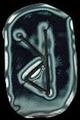

The top rune represents a force that works for you. Raido is the rune of riding, as in a cart or as cargo. It is seen here reversed, suggesting a disruption of travel or communication. Etiological analysis of this rune has also given it interpretations of advice or justice, and of being in a position of moral correctness. Reversed, there is an indication of the lack of solid council, or the holding of a position that is not morally sound.

5.
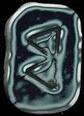

The bottom Rune represents a force that works against you. Berkana, the birch tree, is representative of rebirth, fertility, and a positive outcome to ventures undertaken. It is also the rune of families. Here the rune is reversed, warning you to be heedful of new beginnings, lest they sour. Rebirth is either delayed, or totally disrupted. There is also a warning of family troubles.

If you are further interested in Rune stones, please check out a script I wrote about three years ago. The story tells of a women's chance encounter with the towns rune reader and physcic. Her reading leads to a terrible discovery about her ex-husband.Click here to read 'Evil Of A Different Kind'

Later,
Kenaz

Favourite Easter Movie:Easter Parade

"Judy Garland singing Easter Parade"

Easter Parade Lyrics

Never saw you look quite so pretty before
Never saw you dressed quite so lovely what's more
I could hardly wait to keep our date this lovely Easter morning
And my heart beat fast as I came through the door
For

In your Easter bonnet, with all the frills upon it
You'll be the grandest lady in the Easter parade

I'll be all in clover and when they look you over
I'll be the proudest fellow in the Easter parade

On the Avenue
Fifth Avenue
The photographers will snap us
And you'll find that you're
In the rotogravure

Oh, I could write a sonnet about your Easter bonnet
And of the girl I'm taking to the Easter parade


Originally intended as a re-teaming of Judy Garland and Gene Kelly, EASTER PARADE ran into trouble when Garland's doctors advised against her working under the direction of her husband, director Vincent Minnelli--and no sooner did director Charles Walters take the helm than Gene Kelly broke his leg. Out of such confusion are movie musical miracles born: although a bit old to act as Garland's leading man, Fred Astaire was coaxed out of retirement. He and Garland had tremendous chemistry, EASTER PARADE was a box office smash, and Astaire unexpectedly found himself reborn as an MGM star.

Set in 1900s New York, the film's story line is flimsy but enjoyable. After long-time dance partner Ann Miller abandons the act, Astaire hires chorus girl Garland and attempts to recast her in his former partner's mold--a situation which offers Astaire and Garland considerable comedy and gives Astaire the chance to parody several of his own famous dance of the 1930s. Garland eventually convinces Astaire that she needs to be herself, and once the act is revamped they become a hot ticket--and, once their several romantic complications are resolved, romantic partners as well.

Astaire is every bit as charming here as he was in his Ginger Roger days, and his choreography retains his signature sharpness, wit, and elegance. Although Garland isn't really a dancer, she holds her own with Astaire and she tears strips off a brilliant score of Irving Berlin favorites. Both are well supported by Anne Miller, who gives a brilliant turn with 'Shakin' the Blues Away,' and Peter Lawford, who is quite charming as one of Garland's admirers. Although this really isn't as inspired as the truly great MGM musicals of the late 1940s, director Walters keeps it going at a smart pace, and the star power, clever script, memorable score, and those legendary MGM production values elevate it well above the pack.

Trivia

* Garland's husband Vincente Minnelli was originally slated to direct, but Garland's psychiatrist advised them not to work together.

* The shedding feathered gown worn by Garland in one number is an in-joke reference to Ginger Rogers' problematic gown in Top Hat (1935).

* A Garland solo number, "Mr. Monotony", was cut from the film.

* Gene Kelly was originally scheduled to play Don, but he unexpectedly broke his ankle playing touch football. It was at his suggestion that he be replaced by Fred Astaire. Cyd Charisse was up for the role of Nadine, but her pregnancy forced her to drop out. She was replaced by Ann Miller. Although she had been a star for years, Judy Garland had never met Fred Astaire before, and was afraid to speak to him until they were properly introduced.

* This is the second time that a character says to Judy Garland: "Why didn't you tell me I was in love with you?" in a film. The first was Gene Kelly in For Me and My Gal (1942).

* Ann Miller danced with pinched nerves in her back. Also, she was too tall, so she had to wear flats so she wouldn't be taller than Fred Astaire.

* The dye from the feather on Judy Garland's hat in "Fella with an Umbrella" song, ran all over her face and jacket, so they coated it with vaseline. The feather looks different in two different shots.

Later,
Kenaz