
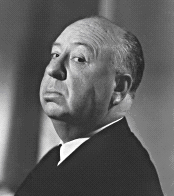
The Master of Suspense, Alfred Hitchcock, began his movie career as an inter-titles designer for silent films in Britain and had just begun directing when sound films were introduced in the late 1920s. Though his early British films were successful, it was the films Hitchcock made after coming to Hollywood in 1939 that made him one of the most recognizable and commercially successful film directors of all time. Oddly enough, though he was nominated for five Best Director Oscars, Hitchcock never won the prize. However, he did received the Irving G. Thalberg Memorial Award from the Academy of Motion Picture Arts and Sciences in 1968.
In his eleventh film, BLACKMAIL (1929), the first talking picture made in Britain, Hitchcock began making now-famous cameo appearances in each of his films. In BLACKMAIL, he can be seen on the subway being harassed by a little boy.
In THE 39 STEPS (1935), one of Hitchcock's most successful films from his early British career, featuring Robert Donat and Madeline Carroll, Hitchcock made his cameo appearance as a litter bug outside a London music hall.
"A Train through Scotland" with Robert Donat and Madeleine Carroll (a .AVI file).
Pursuing greater opportunities than those available in Britain, Hitchcock moved to Hollywood in 1939. His first film made under contract to producer David O. Selznick was an adaptation of Daphne Du Maurier's REBECCA (1940), starring Laurence Olivier, Joan Fontaine and a host of talented British character actors including Judith Anderson, George Sanders, Gladys Cooper, Florence Bates, Nigel Bruce and C. Aubrey Smith. In addition to popularity with critics and audiences, REBECCA also won the Academy Award as Best Picture of 1940 -- Hitchcock's only film to take the top prize.
In 1941, Hitchcock acted as producer and director on SUSPICION, another popular suspense thriller set in his native England (though again filmed in Hollywood) and starring Joan Fontaine as a wife who fears her husband, Cary Grant, only married her for her money and is now trying to kill her. Although SUSPICION marked Hitchcock's last film with Fontaine, it proved to be the first of four successful teamings with Cary Grant whose cool and charming demeanor made him one of Hitchcock's favorite leading men.
In 1943, Hitchcock teamed with playwright Thornton Wilder and went on location in Santa Rosa, California to create SHADOW OF A DOUBT (1943), one of his most neglected masterpieces. Featuring Teresa Wright as a young woman who fears her Uncle Charlie (Joseph Cotten) may be a hunted murderer, and also showcasing memorable character performances by Patricia Collinge and Hume Cronyn, SHADOW OF A DOUBT, Hitchcock often remarked, was the director's personal favorite of all his films
His next film, LIFEBOAT (1944), told the story of a group of shipwrecked passengers stranded in a lifeboat, and starred Tallulah Bankhead alongside William Bendix, Walter Slezak, John Hodiak and Hume Cronyn. It is unique among Hitchcock's films (and films of the period) because all the action is confined to a single set. (Incidentally, this isolated staging required Hitchcock to make his cameo in a newspaper ad.)
In the first of three films Hitchcock would make with David O. Selznick's Swedish import Ingrid Bergman, SPELLBOUND (1945), the director delved into the still-fledgling science of psychoanalysis and hired surrealist artist Salvador Dali to work as art director on the film's famed dream sequence. Though its simplistic approach to analysis dates SPELLBOUND a little, the film is still a fascinating piece of movie making, and co-stars Gregory Peck in one of his earliest screen roles.
Hitchcock's second film with both Ingrid Bergman and Cary Grant, NOTORIOUS (1946), proved to be another smashing critical and box-office success, this time about the daughter of a convicted Nazi spy who agrees to go undercover for the American government in Rio di Janeiro and spy on her father's former associates, including Claude Rains. The key featured on the poster at left is an important prop in NOTORIOUS, and in 1979 when Hitchcock was honored by the American Film Institute with the organization's Lifetime Achievement Award, Ingrid Bergman presented the key to Hitchcock as a token of good luck.
Hitchcock's last film under his contract with Selznick was THE PARADINE CASE (1947), the story of a defense attorney (Gregory Peck) who becomes obsessed with the guilt or innocence of his client (Alida Valli), a women accused of murdering her husband.
More than just a film director and producer, Hitchcock was also an innovator, staying abreast of the latest technologies and pressing the boundaries of the narrative use of special effects. In ROPE (1948), he attempted to create a film without cuts by combining ten-minute-long takes into a seamless flow of action. Inspired by the real-life Leopold-Loeb murder case, ROPE is the story of two young men (Farley Granger and John Dall) who kill a prep-school friend for the thrill of it and invite friends and family to their apartment where the body is hidden. Though interesting, in the final analysis, ROPE is more notable for its experimental approach to filmmaking than for its qualities as a taught thriller. Co-starring Jimmy Stewart and made for Warner Bros., ROPE also marked Hitchcock's first color film.
In STAGE FRIGHT (1950), Hitchcock cheated his audience for the first time by beginning the film with a deceptive flashback which lures the audience into believing what it sees. Despite that shortcoming however, this story of a seductive London actress (played by Marlene Dietrich) whose wealthy husband is murdered and whose young protégé (Richard Todd) is accused of the crime despite the protestations of his aspiring actress friend (Jane Wyman) is still entertaining. Also featuring notable contributions from British character actors Alastair Sim and Joyce Grenfell, STAGE FRIGHT was not one of Hitchcock's most commercially or critically successful films, but it's almost worth watching just to see Marlene Dietrich perform Cole Porter's "The Laziest Girl in Town."
STRANGERS ON A TRAIN (1951) with Farley Granger, Robert Walker and Ruth Roman.
I CONFESS (1953) with Montgomery Clift, Anne Baxter, Karl Malden and Brian Aherne.
THE TROUBLE WITH HARRY (1955) with Shirley MacLaine, John Forsythe, Edmund Gwenn, Mildred Natwick and Mildred Dunnock and a young Jerry Mathers (before "Leave It To Beaver").
DIAL M FOR MURDER (1954) with Ray Milland, Grace Kelly and Robert Cummings.
REAR WINDOW (1954) with Jimmy Stewart, Grace Kelly, Thelma Ritter and Raymond Burr.
TO CATCH A THIEF (1955) with Cary Grant and Grace Kelly.Hitch's first VistaVision film.
THE MAN WHO KNEW TOO MUCH (1956) with Jimmy Stewart and Doris Day.
THE WRONG MAN (1956) with Henry Fonda and Vera Miles.
NORTH BY NORTHWEST (1959) with Cary Grant, Eva Marie Saint, James Mason, Leo G. Carroll and Martin Landau.
PSYCHO (1960) with Janet Leigh, Anthony Perkins, Vera Miles, John Gavin and Martin Balsam.
THE BIRDS (1963) with Tippi Hedren, Rod Taylor, Jessica Tandy and Suzanne Pleshette.
MARNIE (1964) with Tippi Hedren, Sean Connery and Diane Baker.
TORN CURTAIN (1966) with Julie Andrews and Paul Newman.
Complete Filmography
Filmography:
1921 APPEARANCES (inter-titles designer)
1921 THE BONNIE BRIER BUSH (inter-titles designer)
1921 THE CALL OF YOUTH (inter-titles designer)
1921 DANGEROUS LIES (inter-titles designer)
1921 THE GREAT DAY (inter-titles designer)
1921 THE MYSTERY ROAD (inter-titles designer)
1921 THE PRINCESS OF NEW YORK (inter-titles designer)
1922 LOVE'S BOOMERANG (inter-titles designer)
1922 THE MAN FROM HOME (inter-titles designer)
1922 THE SPANISH JADE (inter-titles designer)
1922 TELL YOUR CHILDREN (inter-titles designer)
1922 THREE LIVE GHOSTS (inter-titles designer)
1923 THE WHITE SHADOW (editor, art director)
1923 WOMAN TO WOMAN (screenwriter, editor, art director, assistant director)
1924 THE PASSIONATE ADVENTURE (screenwriter, art director, assistant director)
1924 THE PRUDE'S FALL (screenwriter, art director, assistant director)
1925 THE BLACKGUARD (screenwriter, art director, assistant director)
1925 THE PLEASURE GARDEN
1926 THE LODGER (and screenwriter)
1926 THE MOUNTAIN EAGLE
1927 DOWNHILL
1927 EASY VIRTUE
1927 THE RING (and screenwriter)
1928 CHAMPAGNE (and screenwriter)
1928 THE FARMER'S WIFE (and screenwriter)
1929 BLACKMAIL (and screenwriter)
1929 THE MANXMAN
1930 ELSTREE CALLING
1930 JUNO AND THE PAYCOCK (and screenwriter)
1930 MURDER!
1931 THE SKIN GAME (and screenwriter)
1932 NUMBER SEVENTEEN (and screenwriter)
1932 RICH AND STRANGE
1934 THE MAN WHO KNEW TOO MUCH
1934 STRAUSS'S GREAT WALTZ
1935 THE 39 STEPS
1936 SABOTAGE
1936 SECRET AGENT
1937 YOUNG AND INNOCENT
1938 THE LADY VANISHES
1939 JAMAICA INN
1940 FOREIGN CORRESPONDENT
1940 THE HOUSE ACROSS THE BAY (additional direction)
1940 REBECCA
1941 MR. & MRS. SMITH
1941 SUSPICION
1942 SABOTEUR
1943 SHADOW OF A DOUBT
1944 LIFEBOAT
1944 BON VOYAGE (short)
1944 ADVENTURE MALGACHE (short)
1945 SPELLBOUND
1946 NOTORIOUS (and producer)
1948 THE PARADINE CASE
1948 ROPE (and producer)
1949 UNDER CAPRICORN (and producer)
1950 STAGE FRIGHT (and producer)
1951 STRANGERS ON A TRAIN (and producer)
1953 I CONFESS (and producer)
1954 DIAL M FOR MURDER (and producer)
1954 REAR WINDOW (and producer)
1955 TO CATCH A THIEF (and producer)
1955 THE TROUBLE WITH HARRY (and producer)
1956 THE MAN WHO KNEW TOO MUCH (and producer)
1956 THE WRONG MAN (and producer)
1958 VERTIGO (and producer)
1959 THE GAZEBO (cameo)
1959 NORTH BY NORTHWEST (and producer)
1960 PSYCHO
1963 THE BIRDS (and producer)
1964 MARNIE (and producer)
1966 TORN CURTAIN (and producer)
1969 TOPAZ (and producer)
1972 FRENZY (and producer)
1976 FAMILY PLOT (and producer)
Academy Awards:
1940 REBECCA Best Director Nomination
1944 LIFEBOAT Best Director Nomination
1945 SPELLBOUND Best Director Nomination
1954 REAR WINDOW Best Director Nomination
1960 PSYCHO Best Director Nomination
winner 1967 The Irving G. Thalberg Memorial Award--
given to "a creative producer who has been responsible for a consistently high quality of motion picture production." (It is considered the highest accolade a producer can receive.)
DOWNLOADS
Later,
Kenaz
Pursuing greater opportunities than those available in Britain, Hitchcock moved to Hollywood in 1939. His first film made under contract to producer David O. Selznick was an adaptation of Daphne Du Maurier's REBECCA (1940), starring Laurence Olivier, Joan Fontaine and a host of talented British character actors including Judith Anderson, George Sanders, Gladys Cooper, Florence Bates, Nigel Bruce and C. Aubrey Smith. In addition to popularity with critics and audiences, REBECCA also won the Academy Award as Best Picture of 1940 -- Hitchcock's only film to take the top prize.
In 1941, Hitchcock acted as producer and director on SUSPICION, another popular suspense thriller set in his native England (though again filmed in Hollywood) and starring Joan Fontaine as a wife who fears her husband, Cary Grant, only married her for her money and is now trying to kill her. Although SUSPICION marked Hitchcock's last film with Fontaine, it proved to be the first of four successful teamings with Cary Grant whose cool and charming demeanor made him one of Hitchcock's favorite leading men.
In 1943, Hitchcock teamed with playwright Thornton Wilder and went on location in Santa Rosa, California to create SHADOW OF A DOUBT (1943), one of his most neglected masterpieces. Featuring Teresa Wright as a young woman who fears her Uncle Charlie (Joseph Cotten) may be a hunted murderer, and also showcasing memorable character performances by Patricia Collinge and Hume Cronyn, SHADOW OF A DOUBT, Hitchcock often remarked, was the director's personal favorite of all his films
His next film, LIFEBOAT (1944), told the story of a group of shipwrecked passengers stranded in a lifeboat, and starred Tallulah Bankhead alongside William Bendix, Walter Slezak, John Hodiak and Hume Cronyn. It is unique among Hitchcock's films (and films of the period) because all the action is confined to a single set. (Incidentally, this isolated staging required Hitchcock to make his cameo in a newspaper ad.)
In the first of three films Hitchcock would make with David O. Selznick's Swedish import Ingrid Bergman, SPELLBOUND (1945), the director delved into the still-fledgling science of psychoanalysis and hired surrealist artist Salvador Dali to work as art director on the film's famed dream sequence. Though its simplistic approach to analysis dates SPELLBOUND a little, the film is still a fascinating piece of movie making, and co-stars Gregory Peck in one of his earliest screen roles.
Hitchcock's second film with both Ingrid Bergman and Cary Grant, NOTORIOUS (1946), proved to be another smashing critical and box-office success, this time about the daughter of a convicted Nazi spy who agrees to go undercover for the American government in Rio di Janeiro and spy on her father's former associates, including Claude Rains. The key featured on the poster at left is an important prop in NOTORIOUS, and in 1979 when Hitchcock was honored by the American Film Institute with the organization's Lifetime Achievement Award, Ingrid Bergman presented the key to Hitchcock as a token of good luck.
Hitchcock's last film under his contract with Selznick was THE PARADINE CASE (1947), the story of a defense attorney (Gregory Peck) who becomes obsessed with the guilt or innocence of his client (Alida Valli), a women accused of murdering her husband.
More than just a film director and producer, Hitchcock was also an innovator, staying abreast of the latest technologies and pressing the boundaries of the narrative use of special effects. In ROPE (1948), he attempted to create a film without cuts by combining ten-minute-long takes into a seamless flow of action. Inspired by the real-life Leopold-Loeb murder case, ROPE is the story of two young men (Farley Granger and John Dall) who kill a prep-school friend for the thrill of it and invite friends and family to their apartment where the body is hidden. Though interesting, in the final analysis, ROPE is more notable for its experimental approach to filmmaking than for its qualities as a taught thriller. Co-starring Jimmy Stewart and made for Warner Bros., ROPE also marked Hitchcock's first color film.
In STAGE FRIGHT (1950), Hitchcock cheated his audience for the first time by beginning the film with a deceptive flashback which lures the audience into believing what it sees. Despite that shortcoming however, this story of a seductive London actress (played by Marlene Dietrich) whose wealthy husband is murdered and whose young protégé (Richard Todd) is accused of the crime despite the protestations of his aspiring actress friend (Jane Wyman) is still entertaining. Also featuring notable contributions from British character actors Alastair Sim and Joyce Grenfell, STAGE FRIGHT was not one of Hitchcock's most commercially or critically successful films, but it's almost worth watching just to see Marlene Dietrich perform Cole Porter's "The Laziest Girl in Town."
STRANGERS ON A TRAIN (1951) with Farley Granger, Robert Walker and Ruth Roman.
I CONFESS (1953) with Montgomery Clift, Anne Baxter, Karl Malden and Brian Aherne.
THE TROUBLE WITH HARRY (1955) with Shirley MacLaine, John Forsythe, Edmund Gwenn, Mildred Natwick and Mildred Dunnock and a young Jerry Mathers (before "Leave It To Beaver").
DIAL M FOR MURDER (1954) with Ray Milland, Grace Kelly and Robert Cummings.
REAR WINDOW (1954) with Jimmy Stewart, Grace Kelly, Thelma Ritter and Raymond Burr.
TO CATCH A THIEF (1955) with Cary Grant and Grace Kelly.Hitch's first VistaVision film.
THE MAN WHO KNEW TOO MUCH (1956) with Jimmy Stewart and Doris Day.
THE WRONG MAN (1956) with Henry Fonda and Vera Miles.
NORTH BY NORTHWEST (1959) with Cary Grant, Eva Marie Saint, James Mason, Leo G. Carroll and Martin Landau.
PSYCHO (1960) with Janet Leigh, Anthony Perkins, Vera Miles, John Gavin and Martin Balsam.
THE BIRDS (1963) with Tippi Hedren, Rod Taylor, Jessica Tandy and Suzanne Pleshette.
MARNIE (1964) with Tippi Hedren, Sean Connery and Diane Baker.
TORN CURTAIN (1966) with Julie Andrews and Paul Newman.
Complete Filmography
Filmography:
1921 APPEARANCES (inter-titles designer)
1921 THE BONNIE BRIER BUSH (inter-titles designer)
1921 THE CALL OF YOUTH (inter-titles designer)
1921 DANGEROUS LIES (inter-titles designer)
1921 THE GREAT DAY (inter-titles designer)
1921 THE MYSTERY ROAD (inter-titles designer)
1921 THE PRINCESS OF NEW YORK (inter-titles designer)
1922 LOVE'S BOOMERANG (inter-titles designer)
1922 THE MAN FROM HOME (inter-titles designer)
1922 THE SPANISH JADE (inter-titles designer)
1922 TELL YOUR CHILDREN (inter-titles designer)
1922 THREE LIVE GHOSTS (inter-titles designer)
1923 THE WHITE SHADOW (editor, art director)
1923 WOMAN TO WOMAN (screenwriter, editor, art director, assistant director)
1924 THE PASSIONATE ADVENTURE (screenwriter, art director, assistant director)
1924 THE PRUDE'S FALL (screenwriter, art director, assistant director)
1925 THE BLACKGUARD (screenwriter, art director, assistant director)
1925 THE PLEASURE GARDEN
1926 THE LODGER (and screenwriter)
1926 THE MOUNTAIN EAGLE
1927 DOWNHILL
1927 EASY VIRTUE
1927 THE RING (and screenwriter)
1928 CHAMPAGNE (and screenwriter)
1928 THE FARMER'S WIFE (and screenwriter)
1929 BLACKMAIL (and screenwriter)
1929 THE MANXMAN
1930 ELSTREE CALLING
1930 JUNO AND THE PAYCOCK (and screenwriter)
1930 MURDER!
1931 THE SKIN GAME (and screenwriter)
1932 NUMBER SEVENTEEN (and screenwriter)
1932 RICH AND STRANGE
1934 THE MAN WHO KNEW TOO MUCH
1934 STRAUSS'S GREAT WALTZ
1935 THE 39 STEPS
1936 SABOTAGE
1936 SECRET AGENT
1937 YOUNG AND INNOCENT
1938 THE LADY VANISHES
1939 JAMAICA INN
1940 FOREIGN CORRESPONDENT
1940 THE HOUSE ACROSS THE BAY (additional direction)
1940 REBECCA
1941 MR. & MRS. SMITH
1941 SUSPICION
1942 SABOTEUR
1943 SHADOW OF A DOUBT
1944 LIFEBOAT
1944 BON VOYAGE (short)
1944 ADVENTURE MALGACHE (short)
1945 SPELLBOUND
1946 NOTORIOUS (and producer)
1948 THE PARADINE CASE
1948 ROPE (and producer)
1949 UNDER CAPRICORN (and producer)
1950 STAGE FRIGHT (and producer)
1951 STRANGERS ON A TRAIN (and producer)
1953 I CONFESS (and producer)
1954 DIAL M FOR MURDER (and producer)
1954 REAR WINDOW (and producer)
1955 TO CATCH A THIEF (and producer)
1955 THE TROUBLE WITH HARRY (and producer)
1956 THE MAN WHO KNEW TOO MUCH (and producer)
1956 THE WRONG MAN (and producer)
1958 VERTIGO (and producer)
1959 THE GAZEBO (cameo)
1959 NORTH BY NORTHWEST (and producer)
1960 PSYCHO
1963 THE BIRDS (and producer)
1964 MARNIE (and producer)
1966 TORN CURTAIN (and producer)
1969 TOPAZ (and producer)
1972 FRENZY (and producer)
1976 FAMILY PLOT (and producer)
Academy Awards:
1940 REBECCA Best Director Nomination
1944 LIFEBOAT Best Director Nomination
1945 SPELLBOUND Best Director Nomination
1954 REAR WINDOW Best Director Nomination
1960 PSYCHO Best Director Nomination
winner 1967 The Irving G. Thalberg Memorial Award--
given to "a creative producer who has been responsible for a consistently high quality of motion picture production." (It is considered the highest accolade a producer can receive.)
DOWNLOADS
Later,
Kenaz

