An opening of one's knowledge,capabilities, vision and guidance. The Kenaz is about creating a relationship,learning and allowing room for interpretation. When you are in the darkness,an opening with light is the best and most gracious thing to have bestowed upon you. This is a great time for putting energies into new opportunities. Come share my world as I see it.

Friday, April 07, 2006

Rune Reading For The Period Of April 7-April 16,2006

Introduction to Rune Readings

Rune readings are arrangements of the 24 runes (letters) of the old Futhark alphabet. The layout of the runes is known as a spread, and determines what each rune refers to. For example, in the Three Norns spread, the first rune represents the past, the second the present, and the third the future.

Sets: In addition to each rune having a meaning, the material in which the runes are carved can color the reading. Most people consistently use runes made of ceramic, stone, or wood. In order to broaden your experience, we offer readings with Gold Runes (for questions about business, career, and property), Jade Runes (for questions about love, friendship, and relationships), Ice Runes (for questions about struggle, conflict, and achievement), Spirit Runes (for questions about mysticism, spirituality, and religion), and Stone Runes (for questions about the natural world and things beyond human control).

The question will remain the same: "Will this week be a successful one?"

Rune Alphabet
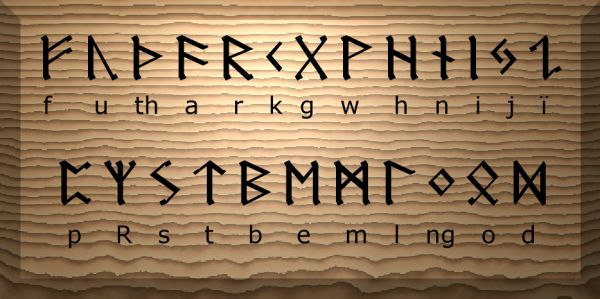


Spread:Cross(in order of reading)
The Cross spread is used to plot the arc of your life and the forces acting on it. It is the most popular spread, giving a very complete view of the situation. Ice Runes are most commonly used for questions about struggle, conflict, and achievement.


Here is the Reading Using the Ice Set.

1.


The left rune represents an important element of the past. Raido means to ride. In this rune, the image is not so much the riding of a horse as in riding in a cart or as cargo. As such Raido may suggest a journey, but is much more indicative of communication. Alternate interpretations based on the use of Raido as a cognate in other words give it the meaning of council, judgment, and moral correctness. Therefore, this rune is the rune of wise advice and good leadership.

2.
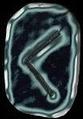

The middle rune represents a deciding element of the present. Ken is the rune of light and knowledge, driving away darkness and ignorance and revealing hidden truth. This rune also brings forth images of friendship and comfort. Ken is the light of inspiration, the light of imagination, and a beacon in the darkest hours.

3.
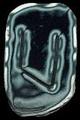

The right rune represents the critical element of the future, at the core of the final outcome. Uruz is the name of the Auroch, an extinct prehistoric ox. This animal was strong and brave, and was the focus of rites of manhood in older days. Reversed, this rune symbolizes either the lack of challenge, or the lack of preparation for a challenge. This rune suggests that you must reach deep within in order to gain the power you will need, whether to get out of your current rut, or to face what appears to be a hopeless situation.

4.
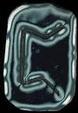

The top rune represents a force that works for you. Perth is the rune of chance and gambling. Throw the dice, read your fate. Gaming is a fine way to pass the night...as long as one is careful. Games of chance have outcomes that are hidden from us, and as such Perth represents secrets unknown. Perth symbolizes enjoyment and wild abandon, but be watchful, for Perth is also the rune of mystery and the outcomes unexpected. You cannot lose if you do not play, but neither can you win...

5.


The bottom Rune represents a force that works against you. Ger is one of the runes that touches on the cycles of the year, in this case the fall harvest. These cycles are eternal, which is represented in the rune by the fact that it is unchanged by reversal. Ger can represent pregnancy or other forms of fruitfulness, and is especially indicative of the cycles of providence and karma - that which has been sown is now being reaped. This rune can also represent the cycles of wealth, for crops were frequently a sign of wealth.

If you are further interested in Rune stones, please check out a script I wrote about three years ago. The story tells of a women's chance encounter with the towns rune reader and physcic. Her reading leads to a terrible discovery about her ex-husband.Click here to read 'Evil Of A Different Kind'

Later,
Kenaz

Hamilton Police Have No Respect For History

The Canadian War Museum is appealing to Hamilton police not to destroy a rare, vintage musket likely used in local battles during the War of 1812. Photos of two guns where then emailed to the Ottawa museum late yesterday afternoon. Thirty seconds later, the museum phoned back.

"You just ruined my day," said special projects director Daniel Glenney. "How do I get that Brown Bess?"

Glenney said the British India Pattern musket was manufactured between 1797 and 1805 and used in Canada by the regular British troops in the War of 1812. It was then used by the Canadian militia in the Upper Canada Rebellion of 1837. Even more interesting is that a soldier's name (WBY Shelburne) is carved into the stock, which should help historians trace the weapon.

Nicknamed Brown Bess for its dark colour, the flintlock was issued to soldiers in Sir Isaac Brock's 49th Regiment of Foot, the King's Regiment and the 41st Regiment of Foot at the turn of the 19th century.

"They would have been carrying those right out of the armouries from England," Glenney said.

The Brown Bess, now locked up with 1,253 other firearms turned in during a month-long police gun amnesty, "could have been used at Queenston Heights, Lundy's Lane and Chippewa," he explained.

"It would have been used by the garrison troops at Burlington Heights all through the war or the Battle of Stoney Creek."

So few remain because the British sold most of the muskets as surplus to the Mexican army, where they were used at the Battle of the Alamo.

Hamilton police have several other weapons that museums would like to have, he said, including a rare Johnson rifle and German MG-34 machine gun from the Second World War, a Remington Rolling Block and a Martini Henry rifle from the 1800s.

And there are suggestions that a weapon owned by a Hamilton man killed with General George Armstrong Custer at the Battle of the Little Big Horn is on the destruction list.

All are due to be melted in a Dofasco blast furnace at the end of April.

"It would be a shame just to melt them down without consideration," Glenney added.

Police subtly softened their stance yesterday, after maintaining all through the amnesty that all weapons would be destroyed regardless of historic value.

The whole point of the gun amnesty is community safety, said Deputy Chief Ken Leendertse. Owners who turned in guns did so knowing they were entering into a contract with police.

"They signed a form that acknowledged they turned it over to the police service for destruction.

"Citizens had an opportunity to turn these weapons over to museums before they turned them over to us."

Nevertheless, police now say they will be flexible if an owner who turned in a gun wants to renegotiate the contract. One owner, who handed over more than 60 firearms, recently asked police to return one with significance to the family.

That will only happen if the owner produces proper papers for it, Leendertse noted. He also left the door open for special entreaties from museums, saying they would be dealt with on a case-by-case basis.

Police have also agreed to check a rumour that a .50- calibre cap-and-ball flintlock belonging to Lieutenant William Winer Cooke was turned in and is slated to be destroyed. If true, the weapon would be of extreme historical importance, given that Cooke, who grew up in Hamilton, died next to Custer in 1876.

He was the author of the famous "last message" to Frederick Benteen that read: "Benteen. Come On. Big village. Be quick. Bring packs. WW Cooke. P.S. Bring Packs."

Police say people must not lose focus on why Hamiltonians want to get rid of guns.

"The people of Hamilton have an intolerance for gun violence," Leendertse said. "If we save one life, that's worth more than any history."

Wouldn't giving the guns to a museum serve both issues of preserving history and getting these guns off the street? Or is the Hamilton Police department hard up for another photo op so they can gloat over doing their jobs.

Later,
Kenaz