
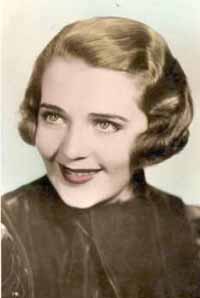
Backed by solid production values, good scores, accomplished casts (including crooner Dick Powell, with whom she was most frequently teamed), and patient directors, Keeler clumped her way through some of the decade's most popular musicomedies:Gold Diggers of 1933, Footlight Parade (also 1933, in which she got to dance with movie tough-guy James Cagney), Dames, Flirtation Walk (both 1934), Go Into Your Dance (her only screen appearance with Jolson), Shipmates Forever (both 1935), Colleen (1936, her personal favorite among her films, and one of her best), and Ready, Willing and Able (1937, in which she danced on giant typewriter keys). When Jolson left Warners in 1937, he insisted Keeler come with him. Consequently, her career came to a screeching halt. Aside from a guest shot in Mother Carey's Chickens (1938) for RKO and a final starring role in Columbia's Sweetheart of the Campus (1941), she never appeared in pictures again. She divorced Jolson in 1940, then married a real-estate man and, essentially, retired. But the lure of the footlights pulled her back, first to guest shots on TV programs, then to Broadway, in a 1970 revival of "No, No, Nanette," directed by none other than Busby Berkeley, and fueled by the popularity (and newly defined "camp" status) of her old films. She made cameo appearances in They Shoot Horses, Don't They (1969, later cut from the film) and The Phynx (1970, which was never released).
Trivia
Although she had been married to Al Jolson's she forbade the use of her name in the film of Jolson's life, The Jolson Story (1946). Portrayed in that film by Evelyn Keyes, Keeler is referred to as "Julie Benson."
Ruby, who was Irish, and her 24-years-senior husband Al Jolson, who was Jewish, could not conceive a child, so they adopted a baby boy who was half-Irish and half-Jewish. After she divorced Jolson she had four children with her second husband. Her adopted son, Al Jolson Jr., was a contented member of her new family.
When 40-year-old Al Jolson, her future husband, first met her at Texas Guinan's El Fey Club in New York City one night in 1926, she was a 16-year-old dancer in the chorus line. He married her two years later, when she was 18.
According to her mother, Al Jolson gave Roby a dowry of $1 million when they were married.
Famous Broadway columnist Mark Hellinger, later to become a movie producer, accompanied ruby and Al Jolson on their honeymoon, to chronicle the event for the "NY Daily News".
Ruby began appearing as a singer and dancer in nightclubs when she was 13 years old, after dropping out of the sixth grade at Catholic school. She would work at two or three clubs a night, making a minimum of $150 a week. Her iceman father, Ralph, had costly medical problems, and she became the Keeler family breadwinner.
When she was a chorus girl in New York City, Ruby was looked after and protected by a gangster named Johnny Irish. An associate of speakeasy owner and bootlegger Owney Madden--who owned the world-famous Cotton Club in Harlem--and an ally of notorious gangster Dutch Schultz, Irish ran Schultz's nightspots for him. The older and married Irish was said not to have had any romantic interest in Keeler but watched over her because she was very young, somewhat naive and also Irish, like himself. When Al Jolson decided to marry Ruby, he went to Irish to tell him of his intentions. Irish warned Jolson that if he ever mistreated Ruby, he'd pay for the transgression with his life.
Later,
Kenaz


No comments:
Post a Comment