In 1914 Canada had just over 3,000 regular soldiers. Based at harbour fortifications, the Canadian Army was backed up by a militia of local volunteers. Expecting a war in Europe, during the summer of 1914 the Canadian government asked for volunteers to join a Canadian Expeditionary Force (CEF).
Over 30,000 Canadian soldiers reached Britain for training at Salisbury Plain in October. Lieutenant-General William Anderson and the 1st Canadian Division arrived on the Western Front in February 1915 and immediately saw action at Ypres. Over the next two weeks the Canadians suffered 5,500 casualties.
Men in Canada were enthusiastic volunteers and by 1916 two more divisions had been sent to France. Commanded by the General Julian Byng, the Canadian Corps successfully took the strategically important Vimy Ridge in April 1917. Byng was replaced by the Canadian officer, General Arthur Currie in June 1917 and he led the Canadians through the Amiens Offensive, the Canal du Nord and the other victories on the Western Front during the later stages of the war.
Almost 600,000 Canadians joined the army during the First World War. Of these, 418,000 served overseas with the Canadian Expeditionary Force (CEF) and sixty-three of these won the Victoria Cross, including William Bishop and John MacGregor. The CEF had 210,000 casualties, of whom, 56,500 were killed.
British War Medal
The British War Medal, instituted on 29 July 1919, was awarded to men who had provided service during and immediately after the First World War.
Initially intended to cover the period 1914-18 it was subsequently extended to those who had given additional service during 1919-20, typically in mine clearance and participation in operations in Russia, the Baltic, Siberia and the Black and Caspian Seas.
Royal Navy servicemen were required to have served for a period of at least 28 days before they were deemed eligible for the British War Medal (or to have lost their lives before then). Men who had enlisted with the O.M.F.C. but who had not seen action were not awarded the medal.
The 36mm medal was circular and made of silver. A bust of King George V featured on the obverse; St George on horseback was on the reverse of the medal, riding over the Prussian shield and skull and crossbones. The dates 1914 and 1918 also featured on the medal's reverse.
Although no additional Bar was made available, there were initial plans to permit such additional awards. Once it became clear however that both the army and navy intended to recommend sizeable numbers the idea was dropped.
In total some 5,670,170 BWMs were awarded, including 110,000 bronze medals awarded to Chinese, Indian and Maltese personnel who had served in labour battalions. Of the wider total approximately 600,000 BWMs were awarded to servicemen from Britain's colonies and dominions
Inter-Allied Victory Medal
Updated - Sunday, 9 March, 2003
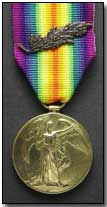
The Inter-Allied Victory Medal (generally referred to simply as the Victory Medal or as the Allied War Medal) was instituted following an agreement by fourteen Allied powers in March 1919.
Intended as a means of providing for a single medal across each of the Allies (removing the need for an exchange of Allied medals, although individual nations issued medals with slight variations), the medal was made from yellow bronze and was 36mm in diameter. The ribbon was officially described as "two rainbows with red in the centre".
The obverse of the medal depicted the winged figure of Victory with her left arm extended while her right held a palm branch. The reverse of the medal contained the legend The Great / War For / Civilization / 1914-1919 across four lines, surrounded by a wreath.
The medal was awarded to all those who had served in the armed forces, as well as to civilians contracted to the armed services, and to those who served in military hospitals on the various battlefronts during wartime. Members of the British Naval Mission to Russia during 1919-20 and men involved in North Sea mine clearance operations were similarly eligible for the medal.
In Britain (and among her colonies and dominions) the Victory Medal was always awarded in concert with another medal, usually the 1914 Star or 1914-15 Star or British War Medal.
No additional Bar was available to accompany the Victory Medal, although men Mentioned-in-Despatches wore an oak-leaf emblem along with the medal.
later,
Kenaz