An opening of one's knowledge,capabilities, vision and guidance. The Kenaz is about creating a relationship,learning and allowing room for interpretation. When you are in the darkness,an opening with light is the best and most gracious thing to have bestowed upon you. This is a great time for putting energies into new opportunities. Come share my world as I see it.

Friday, October 14, 2005

Classic Screen Couples:Fred Astaire and Ginger Rogers

Fred Astaire

"Can't sing. Can't act. Slightly balding. Can dance a little." Fittingly, the studio toad who wrote that screen-test evaluation is long forgotten, but the greatest dancer in movie history is not. With his sister Adele, he danced his way from vaudeville to Broadway, where they starred in hit musicals for nearly 15 years (and reportedly appeared in a 1915 Mary Pickford movie, Fanchon the Cricket He played himself in Dancing Lady (1933), his first film; later that year, he was teamed with Ginger Rogers as the second leads in Flying Down to Rio where their footwork in "The Carioca" stole the show.

RKO quickly realized it had a potential gold mine, and over the next six years Astaire and Rogers made eight more films together, all of them a blend of astonishing choreography (usually in concert with Hermes Pan), brilliant songs by the likes of Irving Berlin, Cole Porter, and Jerome Kern, eye-popping sets, and vintage comedy plots propelled by vintage comedy actors. Buffs all have their favorites, but Top Hat (1935) and Swing Time (1936) are generally considered the best of the lot. (The others: The Gay Divorcee 1934; Roberta 1935; Follow the Fleet 1936; Shall We Dance? 1937; Carefree 1938; The Story of Vernon and Irene Castle 1939) Though worshipped as a dancer, in these and other films Astaire winningly introduced more enduring song hits than any other performer of his generation.

After Rogers broke up the team to concentrate on her acting, Astaire embarked on his "solo" career, giving full vent to his imaginative terpsichorean ideas, and dancing opposite-among others Eleanor Powell in Broadway Melody of 1940 Rita Hayworth in 1941's You'll Never Get Rich and You Were Never Lovelier Bing Crosby in 1942's Holiday Inn and 1946's Blue Skies Gene Kelly in 1946's Ziegfeld Follies Judy Garland in 1948's Easter Parade Jane Powell in 1951's Royal Wedding Cyd Charisse in 1953's The Band Wagon and 1957's Silk Stockings and Audrey Hepburn in 1957's Funny Face as well as reuniting with Rogers in The Barkleys of Broadway (1949).

With the passing of the studio musical, he produced and starred in three TV specials that remain landmarks of the medium. He also took a few straight acting roles in such films as On the Beach (1959), The Pleasure of His Company (1960), The Notorious Landlady (1962), The Towering Inferno (1974, which inex plicably earned him an Oscar nomination), and Ghost Story (1981), made one final musical, Finian's Rainbow (1968), and cohosted the two That's Entertainment! compilations (1974 and 1976), the second of which featured his last dancing on film-alongside compatriot Gene Kelly. Having won two Emmys for his musical specials, he added another for acting in the TV movie A Family Upside Down (1978). In any medium, he epitomized elegance and style. He never won an Academy Award for a specific performance, but did receive a special Oscar in 1949.

Personal Quotes

On modern movies: "They tend to overdo the vulgarity. I'm not embarrassed by the language itself, but it's embarrassing to be listening to it, sitting next to perfect strangers."

Ginger Rogers

To remember her only as the beautiful, vivacious dancing partner of Fred Astaire in their classic 1930s musicals is to do Ginger Rogers a great disfavor: She was a much better actress than most Hollywood wags gave her credit for, even before her Oscar win for Kitty Foyle (1940). Rogers was a performer from childhood, the product of an aggressive stage mother. She danced professionally in vaudeville while still in her teens, married to partner Jack Pepper at the age of 17. Her first film was Campus Sweethearts (1929), a short subject starring Rudy Vallee; she made several minimusicals in New York while performing in the Gershwin stage smash "Girl Crazy," in which she had the second female lead.

Paramount, at that time operating a stu dio in Astoria, Queens, gave Rogers a break in feature films, slotting her in the Claudette Colbert starrer Young Man of Manhattan (1930). She appeared in a few more minor films for the studio before going in 1931 to Hollywood, where she worked as leading lady in a slew of program pictures including The Tip Off, Suicide Fleet (both 1931), Carnival Boat, The Tenderfoot, Hat Check Girl, You Said a Mouthful, The Thirteenth Guest (all 1932), A Shriek in the Night, Broadway Bad, Don't Bet on Love, Sitting Pretty (introducing the song "Did You Ever See a Dream Walking?"), and Chance at Heaven (all 1933). Unlike many attractive young women in Hollywood, Rogers seldom played dewy-eyed ingenues; her characters were nearly always wisecracking, worldly dames who knew their apples.

The year 1933 provided Ginger with her best breaks to date. First, she won star billing for the first time at a major studio in RKO's Professional Sweetheart. Second, she won plum supporting roles in two Warner Bros. musicals, 42nd Street (as monocled "Anytime Annie") and Gold Diggers of 1933 (introducing the song "We're in the Money"-and singing one chorus in pig latin). Third, she was teamed with dancer Fred Astaire for the first time in Flying Down to Rio also for RKO, in which they danced to the lilting strains of the "Carioca."

RKO put Rogers under contract in 1934 (after she'd finished Twenty Million Sweethearts for Warners), developing a starring vehicle for her and Astaire. The Gay Divorcee sported songs by Cole Porter (including "Night and Day") and gave the Astaire-Rogers team plenty of opportunity to strut their stuff. The picture's overwhelming success kept the pair together in a series of delightful, lavishly mounted musicals, all of which featured songs by the country's top tunesmiths (Porter, Irving Berlin, Jerome Kern, the Gershwins) and provided escapist entertainment for Depression-battered moviegoers. Rogers and Astaire were an incomparably well-matched team; as perceptive critics noticed, they seemed to make love through their dance routines, and their smart comic performances as on-again, off-again lovers were a treat. Rogers also made sure she always had one prime solo song in each film. Audiences loved Top Hat, Roberta (both 1935), Swing Time, Follow the Fleet (both 1936), Shall We Dance? (1937), Carefree (1938), and the more serious The Story of Vernon & Irene Castle (1939).

Although RKO allowed her to make films without Astaire-including Romance in Manhattan (1934), Star of Midnight (1935, opposite William Powell in this imitation Thin Man), In Person (1936), Stage Door (1937, in which she provided a lively and engaging counterpart to top-billed Katharine Hepburn), Vivacious Lady, Having Wonderful Time (both 1938), and Bachelor Mother (1939)-she felt she'd never blossom on her own without shedding her demanding dancing partner. For his part, Astaire had had enough of Rogers and the RKO musicals, and was more than willing to leave for greener pastures elsewhere.

After starring in two relatively minor films, Lucky Partners and The Primrose Path Rogers hit pay dirt by letting her blond hair go naturally dark and forgoing glamour-girl treatment to play the feisty, independent working girl in Kitty Foyle (all 1940), pleasantly surprising critics and audiences with her warm, impassioned performance. She won a Best Actress Academy Award, and solidified her position as RKO's top star.

Tom, Dick and Harry (1941) gave her a delightful romantic comedy vehicle. The following year, off the RKO lot, Rogers shined in Roxie Hart (playing a gumchomping, wisecracking publicity hound) and The Major and the Minor (as another high-spirited, self-reliant working girl, who disguises herself as a 12-year-old to save on train fare). By contrast, her RKO vehicles of the period, including Once Upon a Honeymoon (1942) and Tender Comrade (1943), seemed weak. Paramount's overproduced, Technicolor Lady in the Dark though, gave Rogers her first real flop, being the tale (based on a Moss Hart play-but shorn of most of its Kurt Weill-Ira Gershwin songs) of a "boss lady" who undergoes psychoanalysis.

Rogers' star never again shone as brightly, even though she still retained the power to hold and satisfy audiences. Weekend at the Waldorf (1945), Heartbeat, Magnificent Doll (both 1946, miscast in the latter as Dolley Madison), It Had to Be You (1947), The Barkleys of Broadway (1949, reteamed one last time with Astaire, this time at MGM), Perfect Strangers (1950), the highly dramatic Storm Warning and The Groom Wore Spurs (both 1951) saw a gradual diminution in her popularity. She made something of a comeback with three 1952 comedies-We're Not Married, Dreamboat (playing a silent-screen star, a part for which she seemed too young), and Monkey Business-but she couldn't compete with a newer, younger group of stars such as Monkey Business's Marilyn Monroe.

Rogers gave tolerably good performances in Forever Female (1953), Black Widow (1954, as a temperamental actress), Tight Spot (1955), and The First Traveling Saleslady (1956), but found decent starring vehicles fewer and far between, and after Teenage Rebel (also 1956) and Oh, Men! Oh, Women! (1957), she returned to the stage and nightclubs. (Some years later, she played a madam opposite Ray Milland in 1964's mercifully unreleased The Confession/aka Quick, Let's Get Married/aka Seven Different Ways and was Carol Lynley's mother in 1965's Harlow.)

She remained a star, however, as she proved when she took over the leading role in the Broadway smash "Hello, Dolly!" in 1965, and played the title role in the 1969 London production of "Mame." Professionally inactive in her later years, she was confined to a wheelchair but still made myriad personal appearances, especially to promote her 1991 autobiography, "Ginger: My Story." (A 1942 juvenile novel, "Ginger Rogers and the Riddle of the Scarlet Cloak," was written by her mother Lela, who also worked for years as a talent scout and nurturer at RKO, and caused considerable ripples as a Communist witch-hunter in the 1950s.) Rogers was married to actors Lew Ayres (1934-41), Jacques Bergerac (1953-57), and William Marshall (1961-62).

Trivia

The first Rogers and Astaire teaming, Flying Down to Rio (1933), was her twentieth film appearance and only Fred's second.

In a 1991 TV interview when asked why the Astaire/Rogers union wasn't known as 'Ginger & Fred' rather than 'Fred & Ginger' (as Ginger had been in films longer), she replied, 'It's a man's world'.

Personal Quotes

'They're not going to get my money to see the junk that's made today' (1983)

"Hollywood is like an empty wastebasket."

"In everything that I do I learn and try to put it to use. I have learned to go through life not into it. It's like a boat. You mustn't let the water in or you're sunk. Of course, I've made mistakes and I have had failures, but I do not dwell on them because people don't care about garbage. When I make a mistake it's like a bad leaf on a lettuce - I throw it out into the waste basket."

"I don't care what the critics say. My fabulous mom will give me a good review if nobody else does."

[on her partnrship with Astaire] "After all, it's not as if we were Abbott and Costello. We did have careers apart from each other."

"The most important thing in anyone's life is to be giving something. The quality I can give is fun, joy and happiness. This is my gift."


Thursday, October 13, 2005

Top Ten Worst Hollywood Remakes

Bad movie remakes, like extras in a cheesy disaster flick, are too numerous to count. In compiling my list of the 10 worst remakes ever, I just didn't know where to start: There's such an embarrassment of, well, embarrassments. So with that said here is my nominees for the "Ed Wood Award" for personal uncreativity.

10. Godzilla (1998)-A movie about a badly lit big loud lizard in a dumb suit that said nothing unlike the origional 1950's version that represented the atomic and post-atomic experience in Japan.

9. The Longset Yard(2005)- The 1974 Burt Reynolds classic "The Longest Yard" (directed by Robert Aldrich) presented a disgraced pro football wash-up Paul Crewe as so laughingly cynical that, in the film's first five minutes, he's committed violence toward a woman, stolen her car, punched out two cops and been sent to a Texas prison. Adam Sandler reprises the swaggering Reynolds role and turns "The Longest Yard" into "The Waterboy: Part II". There's no excitement for the football game (the guards vs. the prisoners), there's no human dimension and, more importantly, no real anger.

8. Rollerball (2002)- The 1975 James Caan picture was sociologically, politically and personally intriguing and, in many ways, well ahead of its time. So in our current reality-television, extreme-sports addicted culture, a new "Rollerball" showed room for both improvement and enlightenment right? So Obviously wrong, as this mess stains my list. Taking on the gladiator-like sport of Rollerball in, ohhh ... the year 2005, where we revel in the violence and cheer on the players' demise (well, the characters are supposed to anyway), the film went absolutely nowhere except on numerous trips to the editor. Never have we seen a film with so many terrible action cuts. You can't even get into the game. It's such a waste.

7.Swept Away(2002)- Swept Away is one of the most ill conceived remakes ever made. A Italian director Lina Wertmüller's 1974 sex, sand and politics art-house shocker "Swept Away ... By an Unusual Destiny in the Blue Sea of August," is a must see film. Then Madonna came along. The "no good material girl" turns in one of the worst acting performances ever. Most of the blame for this schlock goes to the terrible script and Madonna's hubby, director Guy Ritchie, who is so out of his element here, he flails as much as his wife does stumbling through the sand. Madonna gets slapped around a lot in this picture, but honestly, Mr. Ritchie should have taken some blows.

6.The Texas Chainsaw Massacre (2003)-A low-budget masterpiece of true horror and cinematic artistry, Tobe Hooper's "Texas Chainsaw Massacre" is renowned for its petrifying tension, inventive camerawork, above-par acting (for a B picture; it's both understated and perfectly over-the-top) it's a work of unparalleled brilliance that for some ridiculous reason Hollywood had to tool with. Thank you, producer Michael Bay! They set the remake back in 1973 (Why?).Director Martin Nispel shoots the picture like a video game and amps the gore content for the teen crowd, which goes against the very reason the original "TCM" was so terrifically horrifying: You're so scared, you almost forget how relatively bloodless the film really was. This film is just a bunch of cheap scares and jump cuts and a complete waste of time for horror movie fans.

5.You've Got Mail (1998)- "You've Got Mail" is adapted from the very charming, incredibly sweet and lovingly romantic 1940 classic "The Shop Around the Corner" starring Jimmy Stewart and Margaret Sullavan. Where, in the original, the two opposites unknowingly court each other through a lonely hearts club, the remake has Meg Ryan and Tom Hanks corresponding through e-mail. Though the e-mail concept is contemporary, the love story plays corny and predictable. Worse, the message of supporting Ryan's cute little independent book store (The Shop Around the Corner) is swallowed by the movie's obnoxious use of product placement via the continual use of AOL and well, the title of the movie. It's tantamount to a movie being entitled "Got Milk?" Ugh -- this should have been called "The Schlock Around the Corner."

4.King Kong (1976)-Without a doubt, this update is one of the worst remakes and most painful viewing experiences. I don't know what was worse, the over-acting, the hokey dialogue, the wafer thin plot or the pathetic special effects. How Jessica Lange got hired again after her performance here is a miracle. Granted it was her first movie and it can't have been easy acting opposite an animatronic ape.

3.Psycho (1998)- The shot-for-shot remake of Psycho is, easily, the greatest exercise in inanity imaginable. First, the film is a CLASSIC, inarguably one of the most culturally referenced and widely seen films ever. It is also considered by many to be a masterpiece. It was in many ways revolutionary for its time and for cinema, given that it switched protagonists and had some unique photographic techniques. This is also the calling card film of a truly master craftsman, director Alfred Hitchcock. The idea that this film needed to be remade in any fashion is absurd. And yet, it was. Shot for shot. Literally shot for shot, with much weaker actors. Also, in color. I kid you not. Who on earth thought this would be saleable? You can pop a much, much better version into your DVD player for two bucks. Pointless. Mr. Van Sant is a mediocre filmmaker who sometimes rises above that station, but this was a peculiar indulgence of utter stupidity. Ugh.

2.Planet of the Apes(2001)-Tim Burton decided the 1968 sci-fi classic was in need of updating and turned in this simian stinker. Mark Wahlberg is no Charlton Heston and his portrayal of astronaut George Taylor who somehow ended up on a planet where apes ruled and humans were hunted for sport, is truly bad! What made it even worse was that Burton admitted that it wasn't meant to make any sense in the first place!

1.Herbie the Love Bug(2005)- Michael Keaton plays Lindsay Lohan's father in the Walt Disney Pictures remake of "The Love Bug" titled "Herbie: Fully Loaded." The original film in 1968 told the story of a Volkswagen named Herbie who had a mind of its own. The movie spawned a number of sequels. The modern version with Lohan will be set in the world of NASCAR. I suppose there are worse ways to spend an evening than in the company of this cast and the R2D2-like automobile, but I don't need a root canal. One of many annoying things about this film like this that there's no suspense. It's anti-climactic since we know what the result has to be. There's no mystery, and only the most skilled director can invest this event with energy. Angela Robinson is not up to the task. The lengthy Nextel Championship NASCAR race that represents Herbie: Fully Loaded's final lap is plodding. It's duller than watching a crash-free car race on television.

Dishonourable Mentions:

House of Wax(2005)-The only good thing about this movie is that Paris Hilton dies early in the film.

Bewitched(2005)-Will Ferrell and Nicole Kidman are too talented for this kind of fluff.

The Bad News Bears(2005)-Does anybody else wish Greg Kinnear would just go away.

Oh and if these movies aren't bad enough there is rumored remake of "The Birds" by Michael Bay who brought you pieces of garbage like, (2005) The Island, (2005)The Amityville Horror and (2003)The Texas Chainsaw Massacre. Please! I beg! from the caves of schlockdom, and the lady of smelly cheese herself, 1990's fitness and diet guru 'Susan Powter' I say unto you, "Stop the Insanity!"

Later,
Kenaz

Wednesday, October 12, 2005

From the Set

Today I was once again on the set of the yet to be titled ABC mini-series based on the 9/11 Commssion Report, filming in Toronto. The movie will focus on the days leading up to September 11, with 180 characters, including Harvey Keitel as FBI agent-turned-World Trade Center security head John O'Neill.

Todays scenes had forty of us background stuffed into a cramped mock up of AMERICAN AIRLINES FLIGHT 11. This was the plane that originated from Boston, Massachusetts, scheduled to land in Los Angeles, California. Unfortunately the cruelest evil sent this flight crashing into the north tower of the World Trade Center with 92 people on board.

No one on this set had any difficulty motivating themselves to react rather than act as the writers and wonderful actors portraying the hijackers, pilot John Ogonowski, and Flight attendant Betty Ong did an incredible job in portraying the awful events that unfolded on that September 11.

Hearing the words of Mr.Ogonowski begging with his captors to leave the cockpit, and Mrs. Ong's pleas with American Airlines to help and then having the know all to turn to the helpless passengers and simply ask them to pray definately left me white knucked and breathless. No lie, for a second it felt real. Then cut, it was back to reality, thank the lord.

I hope when this mini series is aired our efforts pay off and what we all see is a true and genuine effort to pay homage to all that felt loss on that day.

Please refer to my previous post to obtain the complete list of everyone who was lost on this flight.american-airlines-flight-11

Later,
Kenaz

Tuesday, October 11, 2005

Vintage Movie Reviews:Fay Wray-Canada's First Scream Queen

Fay Wray will always be remembered as the shrieking, blond Beauty who "killed" the Beast in King Kong (1933), which is a mixed blessing. Without the classic monster movie, Wray's career might be forgotten today. On the other hand (a phrase she used as the title of her 1989 autobiography), her Kong notoriety overshadows her fine work in Erich von Stroheim's The Wedding March. Born in Cardston, Alberta, Canada, raised in Los Angeles, Wray by age 16 was working in low-budget movies. She appeared in Hal Roach comedy shorts and was leading lady to Western stars Hoot Gibson (in 1923's The Man in the Saddle and Art Acord (in 1926's Lazy Lightning but was largely dissatisfied with her screen work until she was signed by producer Pat Powers for The Wedding March in 1926.

Von Stroheim's production went over schedule and over budget, and Powers sold the picture-and Wray's contract-to Paramount. Even in its truncated form, The Wedding March (finally released in 1928) was a masterful film that showcased Wray's virginal beauty. Paramount's The Street of Sin (1927) offered Wray an opportunity to work with German star Emil Jannings and Swedish director Mauritz Stiller. She appeared in The Legion of the Condemned (1927) with Gary Cooper for director William Wellman, and also costarred in Josef von Sternberg's first talkie, Thunderbolt (1929).

The Four Feathers (1929) was an odd hybrid production that combined semidocumentary footage directed by Merian C. Cooper and Ernest Schoedsack with studio footage helmed by German émigré Lothar Mendes, but it gave Wray her first opportunity to work with the team that would create King Kong When she joined the cast of Kong the protracted schedule allowed her to work on several other movies concurrently, especially thrillers and horror films, including a pair of Technicolor thrillers, Doctor X (1932) and The Mystery of the Wax Museum The Vampire Bat (both 1933), and particularly The Most Dangerous Game (1932), which was directed by Schoedsack (with actor Irving Pichel) and shot on the Kong jungle sets at night. Other films from this period include Dirigible, The Unholy Garden (both 1930), One Sunday Afternoon and The Bowery (both 1933).

By the time King Kong finally reached the screen in 1933, Wray was firmly established as the talkie's first "scream queen," a persona she did her best to dispel in subsequent assignments. She acted in prestige pictures such as Affairs of Cellini, Viva Villa!, The Richest Girl in the World and The Captain Hates the Sea (all 1934), but those films, as well as later programmers in which she toiled, did very little for her career. Divorced from screenwriter John Monk Saunders in 1939, Wray married screenwriter Robert Riskin in 1942 and retired from the screen. In the 1950s she returned to character parts in The Cobweb, Queen Bee (both 1955), Rock, Pretty Baby (1956), Tammy and the Bachelor (1957), and her last feature, Dragstrip Riot (1958). Her autobiography, "On the Other Hand" (1989) reveals that Wray had a life much more interesting than the characters she played.

Trivia
Saved RKO from bankruptcy with the movie King Kong. RKO went on to release their most successful film in 1941 "Citizen Kane".

Personal Quotes

"At the premiere of King Kong I wasn't too impressed. I thought there was too much screaming...I didn't realise then that King Kong and I were going to be together for the rest of our lives, and longer...".

"I have come to believe over the years that Kong is my friend" (2004)

"I have no advice for them". [In reference to the King Kong remake and speaking in 2004] (Personal note: This has got to be the most embarassing remake ever made, and that includes Lohan's 'Herbie The Love Bug')

"My scream was a product of pure imagination. I had to imagine what was happening to me, and I imagined that the nearest help was far away. When I first saw the picture I thought the screams were overdone. But they were an important part of the picture and I was delighted with how it all looked. My scenes with King were exactly the way I imagined them" (2004) [In reference to King Kong (1933)]

[In reference to King Kong (1933)] "He (Merion Cooper) called me into his office and showed me sketches of jungle scenes, and told me 'You're going to have the tallest, darkest leading man in Hollywood.' Naturally, I though Clark Gable, But then he showed me this sketch of a giant ape up the side of the Empire State Building, he said 'There's your leading man'" (2004)

"That film changed my life". [In reference to The Wedding March (1928) and speaking in early 2004]

"Von Stroheim never got treated correctly in Hollywood, but he made me feel very happy" (2004)

[On her favourite screen appearance in The Wedding March (1928)] "I still love that film, Eric Von Stroheim was a wonderful human being, and he took a chance on me. I was only 19 when I did the screen test, but he saw something in me. After 75 years, it's still one of the happiest experiences of my life. And it was a nice part, wasn't it?". (2004)


Later,
Kenaz

Monday, October 10, 2005

Silver Screen Couples:Spencer Tracy and Katherine Hepburn

Spencer Tracy

It is one thing for a movie star to earn the adulation of the public. It is another thing to win the praise of the critics. It is still another thing to win the respect and admiration of one's peers, who actually know a thing or two about acting. Spencer Tracy was one of the very few in Hollywood history who won over all three groups. Stocky, round-faced, and not particularly handsome, he nonetheless radiated that peculiar charisma that drew every pair of eyes to his corner of the screen. He could deliver dynamic performances to match any ever filmed, but he could (and usually did) accomplish just as much in a quiet, understated way, mesmerizing audiences with simple gestures, expressions, and body language. The result-invariablywas complete credibility. He made every line of dialogue ring true.

A former Jesuit prep-school student who once intended to become a priest, Tracy joined the Navy in the waning days of World War 1, and upon being mustered out enrolled in Northwestern Military Academy and Wisconsin's Ripon College; in the latter school he took up dramatics, and determined to become an actor. He entered New York's American Academy of Dramatic Arts and studied diligently, even landing a few small roles in Broadway productions. Mostly, though, he supported himself by working in odd jobs. Tracy eventually penetrated New York's community of stock actors, took more Broadway assignments, and finally won a leading role, as a convicted killer on Death Row, in "The Last Mile."

Although Tracy tested the celluloid waters with roles in some New York-filmed short subjects, including 1930's "Taxi Talks" and "Hard Guy," he confided to his wife Louise that, as a decidedly unhandsome character, he had no future in movies. But director John Ford, who'd seen him in "The Last Mile," had Fox sign Tracy to star in a prison yarn he was filming, Up the River (1930, which also featured New York stage actor Humphrey Bogart). Tracy's skillful performance, coupled with his "Last Mile" fame, kept him confined to gangster and tough-guy roles for his first several years in Hollywood. He was already a better actor than many of the leading men out there (having mastered early the technique of underemoting for the camera), but studio brass insisted on casting him as a thick-ear type in the likes of Quick Millions, Six-Cylinder Love, Goldie (all 1931), Sky Devils, Disorderly Conduct, Young America, Society Girl, The Painted Womanthe delightful Me and My Gal and She Wanted a Millionaire (all 1932), among others.

An increasingly truculent Tracy, loaned to Warners for yet another prison picture (1933's 20,000 Years in Sing Sing took to drinking heavily and grousing loudly. Fox loaned him to Columbia to star opposite Loretta Young (with whom Tracy was once romantically linked) in Frank Borzage's Depression romance, Man's Castle (1933), and did offer him some better roles, as the itinerant sign painter in Face in the Sky (also 1933), for example. Producer Jesse L. Lasky even selected him to star in his prestigious, innovative drama, The Power and the Glory (also 1933), playing the ruthless industrialist with a tragic personal life. The literate, handsome production (written by Preston Sturges) was not a box-office success, and Tracy finished out his Fox contract in mostly undistinguished fare, including The Mad Game, Shanghai Madness(also 1933), The Show-Off, Bottoms Up, Now I'll Tell, Marie Galante (all 1934), and It's a Small World (1935). (Two of his better outings during this period were 1934's jaunty Looking for Trouble and 1935's Dante's Inferno

MGM's wonder boy, production head Irving Thalberg, thought Tracy would make an ideal secondary lead and character actor, and signed him in 1935 to a long-term contract. That year, after getting top billing in a nondescript B, The Murder Man Tracy took the number two spot supporting Metro stars Myrna Loy (in Whipsaw and Jean Harlow (in Riffraff as well as borrowed Paramount star Sylvia Sidney (in 1936's Fury a Fritz Lang drama in which Tracy made his best impression to date for MGM). He supported Clark Gable and Jeanette MacDonald in San Francisco (and was Oscar-nominated for his work as a priest), and William Powell, Myrna Loy, and Jean Harlow in Libeled Lady (both 1936) before being cast as the Portuguese fisherman Manuel, in support of child star Freddie Bartholomew, in Victor Fleming's letter-perfect adaptation of Kipling's Captains Courageous (1937), a characterization that won him his first Academy Award.

Tracy's next few assignments-in They Gave Him a Gun, The Big City, Mannequin (all 1937), and Test Pilot (1938, again in support of Gable and Loy)weren't particularly demanding, nor were the films particularly great. But Boys Town (also 1938) offered him the plum role of a real-life hero, Nebraska's famous Father Flanagan, whose private community for wayward boys had made headlines. Tracy superbly limned the priest as tough but tender, and won a second Academy Award for his portrayal. (He reprised the role in a 1941 sequel, Men of Boys Town

Loaned to 20th Century-Fox for Stanley and Livingstone (1939, in which he played the former, uttering the immortal line "Dr. Livingstone, I presume."), Tracy returned to Metro first to support Gable and Claudette Colbert in Boom Town but then appeared in several top-notch starring vehicles: Edison, the Man the rugged Northwest Passage, I Take This Woman(all 1940), and Dr. Jekyll and Mr. Hyde (1941). In 1942 Tracy was teamed for the first time with Katharine Hepburn, who had made a surprising comeback-after being labeled "box-office poison" by exhibitors-in Metro's The Philadelphia Story. Woman of the Year (1942) was a delightful comedy directed by George Stevens that showed them playing out the battle of the sexes with élan; it was a routine they would evolve together periodically onscreen over the next quartercentury. An offscreen romance began as well, although Tracy-a devout Catholic-refused to divorce his wife, even though they lived apart for decades.

Tracy, by this time a top star at MGM, worked throughout the 1940s: Keeper of the Flame (with Hepburn), Tortilla Flat (both 1942), A Guy Named Joe (1943), The Seventh Cross, Thirty Seconds Over Tokyo (both 1944), Without Love (1945, with Hepburn), Cass Timberlane, Sea of Grass (both 1947, the latter with Hepburn), Edward, My SonHe always seemed at his best with Hepburn, and most of their films were unusually intelligent. In State of the Union (1948, based on the hit Broadway play), he's an indus- trialist who tries to maintain his integrity while running for President; Hepburn is his wife, who loses faith in him when he seems to be swallowed by the political machine (and its power broker, played by Angela Lansbury). In Adam's Rib (1949, written especially for them by their friends Ruth Gordon and Garson Kanin, and directed by another close friend, George Cukor) they're a liberated married couple, both successful as lawyers, who lock horns when they represent opposing sides in a love-triangle shooting.

Acting didn't come easily for Tracy, a tormented man who would disappear on binges for days, even weeks at a time. Still, he managed to rein himself in often enough to work on a steady basis, and toplined such 1950s vehicles as The People Against O'Hara (1951), Plymouth Adventure (1952), The Actress (1953, as the father of a budding actress, an autobiographical story by Ruth Gordon), Broken Lance (1954), and The Mountain (1956). He gave one of his most endearing performances in Father of the Bride (1950), as the hapless (but doting) dad of Elizabeth Taylor, and earned another Oscar nomination; he and his costars fared equally well in a sequel, Father's Little Dividend (1951).

He snagged another Oscar nod as the grizzled, one-armed veteran who exposes a Western town's dirty little secret in Bad Day at Black Rock (1955), and yet another for his tour de force as an aging fisherman battling the elements in Hemingway's The Old Man and the Sea (1958). He found other good opportunities in the 1950s: opposite Hepburn again in Pat and Mike (1952) and Desk Set (1957), and reunited with director John Ford and an all-star cast in the sentimental The Last Hurrah (1958), which offered him a tailor-made role as an old-time politico.

By this time Tracy was white-haired and craggy-faced, his natural contrariness and irascibility gradually seeping into his performances. Inherit the Wind (1960), based on the real-life "monkey trial" of 1925, cast him as a fictionalized Clarence Darrow, a characterization that garnered him yet another Academy Award nod. He repeated the feat with his turn as the U.S. judge presiding over Nazi war criminals' trials in Judgment at Nuremberg (1961). But he couldn't save The Devil at 4 O'Clock (1961, playing a priest for the last time), and had little to do as the nominal straight man to a cast of scenestealing comics in It's a Mad Mad Mad Mad World (1963). He also narrated the epic western How the West Was Won in 1962.

Increasingly ill, Tracy returned to the screen just once more, at the behest of his friend, producer Stanley Kramer, to costar with his beloved Hepburn one last time in Guess Who's Coming to Dinner (1967). An occasionally syrupy but well-intentioned and well-made plea for racial tolerance, it provided a fitting swan song for this great actor, who delivered a lengthy, moving speech in the final reel. Desperately ill during production, Tracy summoned up his last ounce of strength to finish the picture; he died just a few weeks after shooting was completed. He received a posthumous Best Actor Academy Award nomination-his ninth-for his performance.

Trivia

Katherine Hepburn and Spencer Tracy acted together in 9 movies: Adam's Rib (1949), Desk Set (1957), Keeper of the Flame (1942), Pat and Mike (1952), The Sea of Grass (1947), State of the Union (1948), Without Love (1945), Guess Who's Coming to Dinner (1967) and Woman of the Year (1942).

Katharine Hepburn, his frequent screen partner and longtime flame, never watched Guess Who's Coming to Dinner (1967) because it was his last film and watching it with him gone was too painful for her.

In 1956/57 when his longtime friend Humphrey Bogart was dying of cancer, Tracy and Katharine Hepburn were two of the only people who visited Bogie (and wife Lauren Bacall) at their home on an almost daily basis. They would sit together at Bogie's bedside for half an hour or so every evening in the months and weeks leading up to his death. After Bogie's death, Bacall requested that Tracy deliver the eulogy at the funeral. He apologetically declined, saying it would simply be too difficult for him. He felt he would be too emotional and wouldn't be able to do it. Bacall understood and director John Huston delivered the eulogy instead.

Tracy was offered the role of The Penguin in the TV series "Batman" (1966/II) before Burgess Meredith. He said he would only accept the role if he was allowed to kill Batman.

Personal Quotes

On acting: "Come to work on time, know your lines and don't bump into the other actors."

"I couldn't be a director because I couldn't put up with the actors. I don't have the patience. Why, I'd probably kill the actors. Not to mention some of the beautiful actresses."

On being asked why he was always billed above Katharine Hepburn in their films together, when politeness dictated the other way around: "Because this is a movie, you chowderhead, not a lifeboat!"

"The kids keep telling me I should try this new "Method Acting" but I'm too old, I'm too tired and I'm too talented to care."

Katherine Hepburn

She was branded "box-office poison" by the nation's exhibitors in 1938, but Katharine Hepburn has come to be regarded as a national treasure. One of the most frequently honored screen actresses (with eight Academy nominations and four Oscars to her credit), Hepburn came to films in A Bill of Divorcement (1932), as John Barrymore's daughter, following a sometimes tempestuous career on stage in amateur theatricals, college shows, stock, and finally on Broadway. Her unusual looks and manner-and her unique New England voice-put off some moviegoers at first, but her endearing performance as a naive, impulsive young actress trying to crash Broadway, in 1933's Morning Glory won her her first Academy Award. Hepburn proved her versatility in such pictures as Little Women (1933), The Little Minister (1934), Alice Adams (1935, for which she received an Oscar nomination), Mary of Scotland (1936), and the wonderful Stage Door (1937, an interesting companion piece to Morning Glory But for every success in her early Hollywood career, there was also a major misfireincluding such all-time oddities as Christopher Strong (1933, in which she played an aviatrix) and Sylvia Scarlett (1935, in which she disguised herself as a boy).

By the time she made the classic screwball comedy Bringing Up Baby (1938, for which the understandably nervous actress took comedy "pointers" from veteran screen funnyman Walter Catlett) and the equally delightful comedy-drama Holiday (also 1938), Hepburn's film career was on the skids. (Although it was that same year that Walt Disney immortalized her in cartoon form, as a haughty Little Bo-Peep in his animated short subjectMother Goose Goes Hollywood She returned to Broadway to star as spoiled socialite Tracy Lord in Philip Barry's "The Philadelphia Story," forsaking a huge salary for a percentage of profits and title to the screen rights. Her successful gamble paid off, and led to an equally triumphant return to Hollywood in the 1940 film version, which earned her another Oscar nomina tion. She was nominated again for her next film, Woman of the Year (1942) which cast her as an opinionated newspaper columnist opposite Spencer Tracy (as a down-to-earth sportswriter). It was a match made in movie heaven; the two would star in eight subsequent films over the next 25 years. (They also commenced an offscreen relationship that lasted until his death.)

Some of the early Tracy-Hepburn collaborations were heavy dramas such as Keeper of the Flame (1942) and The Sea of Grass (1947). Dramatic fireworks flew as well in State of the Union (1948), but the team is best remembered for its humorous skirmishes in the battle of the sexes with Without Love (1945), Adam's Rib (1949), Pat and Mike (1952), and Desk Set (1957). While Hepburn's work in the 1930s and 1940s receives the most attention today, many of the star's peak achievements were realized in the 1950s and 1960s. She picked up Oscar nominations for her work in The African Queen (1951, opposite Humphrey Bogart, as a missionary whose personality she patterned after Eleanor Roosevelt), Summertime (1955), The Rainmaker (1956), Suddenly, Last Summer (1959, as Elizabeth Taylor's shrewish, sinister aunt), and Long Day's Journey Into Night (1962). Offscreen for five years, she returned to costar with Tracy in Guess Who's Coming to Dinner (1967), which proved to be his final film; it won her a second Oscar. Hepburn received her third gold statuette the following year for her work in the period drama The Lion in Winter as Eleanor of Aquitaine, which showed the aging actress in full command of her inestimable talent. She followed this triumph by making her Broadway musical debut as couturier Coco Chanel in "Coco." Other films around this time include The Madwoman of Chaillot (1969), The Trojan Women (1972), and A Delicate Balance (1973).

A much-anticipated pairing of Hepburn with John Wayne yielded disappointing results, as Rooster Cogburn (1975) turned out to be a watered-down retread of The African Queen But her teaming with another screen giant, Henry Fonda, in On Golden Pond (1981), brought her a fourth Best Actress Academy Award, and proved to be her finest latter-day film. Hepburn's TV work has largely been confined to long-form dramas. She received Emmy nominations for Tennessee Williams' "The Glass Menagerie" (1973), and "The Corn Is Green" (1979), directed by her longtime friend and collaborator, George Cukor. She won an Emmy for "Love Among the Ruins" (1975), also directed by Cukor and costarring Laurence Olivier. Since that time she has starred in several "star-vehicle" TV movies, including Laura Lansing Slept Here (1988), The Man Upstairs (1992), and This Can't Be Love (1994). Her 1991 autobiography, "Me," was a best-seller, as was her more specific 1987 memoir, "The Making of The African Queen or How I Went to Africa with Bogart, Bacall and Huston and Almost Lost My Mind." After years away from the big screen, Hepburn was coaxed back to do Love Affair (1994); she provided that film's highlight, as Warren Beatty's aunt.

Trivia

Was a leading choice to play "Scarlett O'Hara" in Gone with the Wind (1939).

Was a direct descendant of Britain's King John through one of his illegitimate children.

Quotes

"Acting is a nice childish profession - pretending you're someone else and at the same time selling yourself."

"Enemies are so stimulating."

Adams Rib 1949


Desk Set 1957


Later,
Kenaz

Tarot Card Reading For The Week Of October 10-16, 2005

The Question:"Will this week be a successful one?"

Review of the ten card Celtic Spread.

The the deck is first spread out face down in the middle of the table and mixed up thoroughly. The cards are then gathered and played out one card at a time, face up as follows.

The Celtic Cross spread is one of the most common tarot spreads. There is a cross in the center, with a row of 4 cards along the side. This spread will provide a fairly in-depth look at a situation including past, present and external influences. Beginners may want to start with a spread with fewer cards.

Here is the reading.

Cover: General atmosphere

Page of Swords
SOMEONE'S IMPULSIVE ACTIONS OR BEHAVIOR WILL BRING TROUBLE FOR YOU, BE CAREFUL WITH THINGS RELATED TO LAW AND CONTRACTS.

Crossing: Opposing forces

King of Cups
SOMEONE WILL BE OF AID TO YOU, OR BE A BENEFACTOR FOR YOU.

Foundation: Past basis

The Wheel of Fortune
AN UNEXPECTED EVENT WILL BRING A MAJOR CHANGE IN YOUR LIFE, YOU WILL SEE THINGS CHANGING YOUR WAY, AS LADY LUCK SMILES ON YOU, YOU WILL ALSO BE HAVING A LUCKY STREAK, AND WILL WIN OR COME AHEAD ON ANYTHING RELATING TO CHANCE.

Behind You: Passing influences

Knight of Swords
SOMEONE UPSETS YOU BY CAUSING MISCHIEF WITH BAD INTENT.

Crowining: Possible future

Two of Swords
YOU WILL BE TRYING TO MAKE A DECISION THAT YOU FIND HARD TO MAKE, BECAUSE YOUR HEART WILL TELL YOU ONE THING AND YOUR MIND ANOTHER, YOUR INDECISION WILL BOUND YOU TO A BAD SITUATION.

Before You: Soon to come

Six of Cups
YOU WILL BE REUNITING OR SPENDING TIME WITH SOMEONE FROM YOUR PAST

Hopes: Goals or aspirations

Eight of Swords
YOU ARE FEELING TRAPPED OR BOUND BY A SITUATION, AND CAN'T SEE A WAY OUT OF IT

Opinions: What others think

Nine of Wands
YOU ARE EXPERIENCING A PAUSE IN A SITUATION JUST BEFORE THINGS START MOVING AGAIN.

Feelings: Fears

The Fool
YOU WILL ACT OUT OF CHARACTER AS YOU TAKE A RISK ON A FRESH START OR NEW BEGINNING IN YOUR LIFE.

Outcome: Resolution

Seven of Wands
OTHERS ARE OPPOSING YOU AND WHAT YOU WANT OR HAVE, YOU WILL STAND TOE TO TOE AND TAKE A STAND FOR WHAT YOU WANT AND BELIEVE.

Quintessence:

The Hermit
DO NOT LET YOURSELF BE MANIPULATED, AND SPEND TIME IN QUITE REFLECTION TO FIND YOUR ANSWERS.

Later,
Kenaz

Happy Thanksgiving To All My Canadian Readers

From me to you, I hope today is full of happiness and joy. As you sit with your loved ones to enjoy the seasons bounty, please remember all those less fortunate.

Have a great day,
Kenaz

From me to you,

Beautiful Season-Courtesy of Yahoo Greatings

Sunday, October 09, 2005

Vintage Movie Reviews:Charles Laughton

It would be easy to think that as distinctive looking a performer as Laughton-roly-poly, fish-faced, with thick, blubbery lips and sleepy eyeswould be typed based on his physical appearance and play the same kinds of parts throughout his career. But this hugely talented English actor refused to be pigeonholed, either in his native England or later in Hollywood-and, as a result, left behind a wide gallery of portrayals, many of which rank among the movies' most colorful. A former hotel clerk who enrolled in Britain's prestigious Royal Academy of Dramatic Art after World War 1, Laughton made his professional stage debut in London's West End in 1926. He made several silent comedy shorts in 1928, and it was during production of these that he met Elsa Lanchester, whom he married in 1929. Coming to America in 1931 with the play "Payment Deferred," in which he played an unlikely murderer, Laughton eventually went to Hollywood to star in MGM's screen adaptation (released 1932).

Within a very short time Laughton had appeared in The Old Dark House, The Sign of the Cross (both 1932, in the latter as a pouty Nero), and The Island of Lost Souls (1932, as the evil Dr. Moreau). He also had a memorable cameo appearance in a vignette in Paramount's all-star If I Had a Million (1932), as the man who gives his boss the razzberry. Laughton was subsequently counted on to bring a patina of real English class to the literary adaptations MGM essayed in the early to mid 1930s. Of course, he brought a lot more than just that, delivering bravura performances as Captain Bligh in Mutiny on the Bounty (an Oscar-nominated turn), and Javert in Les Miserables both made in 1935. (He was replaced, however, in the role of Micawber in David Copperfield by W. C. Fields.) He also showed off his comic skills as a deferential British butler transplanted to the American West in Ruggles of Red Gap (1935). His recitation of the Gettysburg Address was particularly memorable.

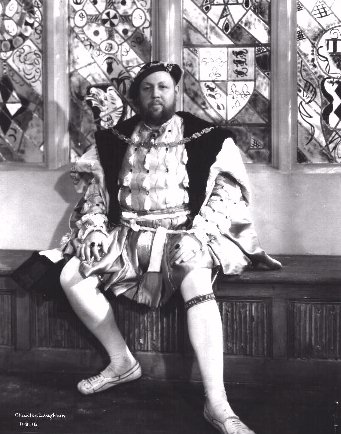
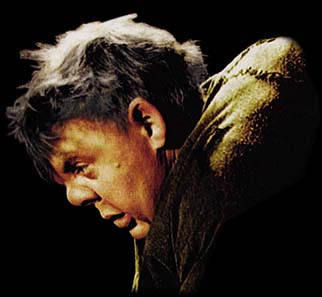
Laughton bounced back and forth between Britain and America during the 1930s, working in two memorable movies directed by Alexander Korda: The Private Life of Henry VIII (1933, for which he won a Best Actor Oscar) and Rembrandt (1936). He showed his lighter side, as a street entertainer or "busker," in Sidewalks of London (1938, original British title, St. Martin's Lane). Back in Hollywood, his poignant turn as Quasimodo in 1939's The Hunchback of Notre Dame-smothered as he was under heavy makeup-won Laughton more critical acclaim. He worked steadily in Hollywood during World War 2, being especially memorable in The Canterville Ghost (1944) and Captain Kidd (1945). He wasn't always successful at restraining his urge to chew the scenery, but he was capable of subtle, understated performances when he had good scripts and good directors. He was very effective in The Big Clock (1948), a thriller that casts him as a publishing magnate with a horrible secret, played French detective hero Maigret in The Man on the Eiffel Tower (1950), and tackled Henry VIII again in Young Bess (1953).

In 1955 Laughton directed his only film, the strange and beautiful Night of the Hunter written by James Agee and starring Robert Mitchum and Lillian Gish. Although well received (it's considered a minor classic today), this thriller did not lead to any more directing assignments and Laughton continued acting; his last few films feature some of his best characterizations, including an eccentric lawyer in Witness for the Prosecution (1957, Oscar-nominated) and a corrupt Roman senator in Spartacus (1960). His last film was Advise and Consent (1962).

OTHER FILMS INCLUDE: 1933: White Woman 1938: The Beachcomber 1939: Ja- maica Inn 1940: They Knew What They Wanted 1941: It Started With Eve 1942: Stand By for Action, Tales of Manhattan, The Tuttles of Tahiti 1943: Forever and a Day, The Man From Down Under, This Land Is Mine 1944: The Suspect 1946: Because of Him 1947: The Paradine Case 1948: Arch of Triumph 1949: The Bribe 1951:The Blue Veil, The Strange Door 1952:Abbott and Costello Meet Captain Kidd, O. Henry's Full House 1953: Salome 1954:Hobson's Choice

Personal Quotes:

"Method actors give you a photograph. Real actors give you an oil painting." Laughton was a real actor.

As King "Henry the VIII"


As Quasimodo from "Hunchback of Notre Dame"


Later,
Kenaz

Saturday, October 08, 2005

Vintage Movie Reviews:Gary Cooper

The movies' archetypal "strong, silent type," this tall, laconic leading man defined Hollywood heroism in a way most other actors never could. Many of his characters, whether by choice or design, were cut from distinctly American cloth: slow to anger, predisposed to peaceful solutions, but unafraid to use force rooted in justice. Although the softspoken Cooper was a college graduate (and briefly, a newspaper cartoonist), his saddle skills-hard won in his Montana youth-actually got him into movies, first as an extra in numerous Hollywood Westerns, then as an eleventh-hour replacement for the second male lead in Henry King's The Winning of Barbara Worth (1926), in which the lanky young man managed to steal many of the scenes he shared with matinee idol Ronald Colman-a notinconsiderable feat that led Paramount Pictures to sign him.

Initially he supported the studio's top stars-Clara Bow in It (1927) and Children of Divorce (1927), Bow, Richard Arlen, and Buddy Rogers in the Oscarwinning Wings (1927)-but made his own mark as a top-billed star of Paramount's program Westerns, including 1927's Arizona Bound, Nevada and The Last Outlaw. He was paired with Colleen Moore in Lilac Time and Nancy Carroll in Shopworn Angel two successful 1929 dramas set during World War 1. Talkies found Cooper refining his naturally taciturn Western character; in The Virginian (1929), he rarely spoke unless he had something to say, including the famous line, "When you call me that, smile" delivered to swearing badman Walter Huston. In 1930 he starred in The Texan and A Man From Wyoming (as well as taking a cameo in the all-star Paramount on Parade) before being teamed with exotic Marlene Dietrich in Morocco a scorching desert romance that found him in Legionnaire's garb, and led him away from Westerns. Although Cooper frequently essayed roles that called for him to be shy or reticent, his offscreen conduct vitiated that image; his affairs with Bow, Lupe Velez, and others were both numerous and well known.

Cooper played a hard-boiled gunman in City Streets (1931), a gangster story written by Dashiell Hammett; his performance suggests that he'd have been right at home playing one of Hammett's pulp-fiction detectives. I Take This Woman, His Women (both 1931), The Devil and the Deep and A Farewell to Arms (both 1932, the lastnamed a Hemingway adaptation costarring Helen Hayes) refined and reinforced his new image as a romantic leading man. And, while ostensibly miscast as an artist in Ben Hecht's spicy adaptation of Noël Coward's witty Design for Living (1933, directed by Ernst Lubitsch), Coop acquit ted himself admirably. It's unfortunate that he didn't choose to appear in more comedies, because he certainly had the knack. He continued to top-line some of Paramount's most successful films of the 1930s, including The Lives of a Bengal Lancer (1935), Desire and The General Died at Dawn (both 1936), before going to Columbia to star as small-town sage Longfellow Deeds in Mr. Deeds Goes to Town (1936), one of Frank Capra's best populist comedies and one of Cooper's signature roles; it earned him his first Oscar nomination.

Back at Paramount he played a romanticized Wild Bill Hickok in Cecil B. DeMille's The Plainsman (1936) and starred in Souls at Sea (1937) before tackling (most improbably) the title character in The Adventures of Marco Polo (1938), continuing a working relationship with producer Sam Goldwyn begun with The Wedding Night (1935). He lapsed back into "shucks, ma'am" mode for Goldwyn's formula comedy The Cowboy and the Lady pleasantly paired with Merle Oberon. It fared better than Bluebeard's Eighth Wife (1938), a rare misfire for Lubitsch (working from a Billy Wilder-Charles Brackett script, no less). Beau Geste (1939) saw him back in form; although hardly the type to play an aristocratic young Englishman who joins the Foreign Legion to save his family from disgrace, Cooper cut a dashing figure in the distinctive Legionnaire uniform, and the surefire remake of the 1926 film was a solid hit. Two more Goldwyn-produced efforts, The Real Glory (1939) and The Westerner (1940, in which he matched wits with Walter Brennan's Judge Roy Bean), preceded Cooper's return to DeMille for Northwest Mounted Police (1940), a robust if somewhat silly Technicolor actioner.

Cooper's next four films set a highwater mark in screen acting-and sheer starpower-seldom (if ever) equaled since. He played an idealistic hobo turned media hero in Frank Capra's bittersweet Meet John Doe (1941), then portrayed real-life pacifist-turned-WW1 hero Alvin York in Sergeant York later that year, winning the Best Actor Oscar for his performance. Ball of Fire (also 1941, a Goldwyn picture directed by Howard Hawks) showed he hadn't forgotten how to play comedy; as one of the prissy pro fessors who enlists wisecracking burlesque dancer Barbara Stanwyck to help them with a slang encyclopedia, Cooper showed himself to be a terrific straight man. And The Pride of the Yankees (1942, also for Goldwyn), featured him as baseball great Lou Gehrig (then recently deceased) in a touching, warm biopic that yielded another Oscar nomination.

He earned another Oscar nod for his hardbitten performance in For Whom the Bell Tolls (1943), based on the novel by his friend Ernest Hemingway, but his next few vehicles, while certainly pleasant, suggested that he might be marking time: The Story of Dr. Wassell, Casanova Brown (both 1944, the former directed by Ce- cil B. DeMille), Along Came Jones (1945, which he also produced), Saratoga Trunk (1945), Cloak and Dagger (1946), Unconquered (1947), and Good Sam (1948). Cooper was riveting as the iconoclastic architect in The Fountainhead (1949), an ambitious but middling Ayn Rand adaptation. More routine films followed-Task Force (1949), Bright Leaf, Dallas (both 1950), and You're in the Navy Now (1951) among them-before an aging, wearylooking Cooper assumed what may be his greatest role, that of the embattled marshal abandoned by the townspeople he spent years protecting, in High Noon (1952), a controversial film that was at once both the epitome and the antithesis of the "traditional" Western. The Academy presented him with another Oscar for his sterling performance.

In the Indian Summer of his career, Cooper starred in a number of meritorious productions that used his age as an asset-including The Court-Martial of Billy Mitchell (1955), Friendly Persuasion (1956), Love in the Afternoon (1957, paired romantically with Audrey Hepburn and directed by Billy Wilder), Man of the West (1958), and The Hanging Tree (1959)-but his energies seemed to wane with each passing film. The Naked Edge (1961), a routine thriller shot in England, showed a listless Cooper just going through the motions; it proved to be his last film. In April 1961 he won a special, career-achievement Academy Award, which was accepted by his friend James Stewart. By that time a cancer-riddled Cooper was too ill to accept it. A month later he was dead.

"Gary Cooper-The Pride of the Yankees (1942)"


"Gary Cooper and Helen Hayes in a scene from Ernest Hemingway's A Farewell to Arms (1932)"


Later,
Kenaz

Friday, October 07, 2005

Silver Screen Couples:Jeanette McDonald and Maurice Chavalier

Jeanette McDonald

This musical star may not have been the biggest box-office draw of all time, but she still has an international fan club, and a devoted following, indicative of the impact she made on-screen. She was a Broadway chorus girl in the early 1920s, but was soon picked to play leads in operettas and musical comedies. Given a screen test at Paramount's New York studio in 1929, she was chosen by director Ernst Lubitsch to costar with French singing sensation Maurice Chevalier in The Love Parade the success of which made her one of the most popular female stars of the early talkie era. Pretty and vivacious (but, oddly, without much sex appeal), MacDonald's saucy characterizations in her early films for Lubitsch are quite at odds with the image she later presented as a star at MGM.

She starred in The Vagabond King Lubitsch's Monte Carlo, Let's Go Na- tive, Lottery Bride, Oh for a Man! (all 1930), Don't Bet on Women, Annabelle's Affairs (both 1931), Lubitsch's One Hour With You, Love Me Tonight (both 1932, reteamed with Chevalier in two of her best screen outings), The Cat and the Fiddle and The Merry Widow (both 1934, the latter marking her final film with Chevalier and director Lubitsch) before her first fateful teaming with Nelson Eddy.

The movie operetta had enjoyed some popularity in the early talkie years, but the form was largely moribund in 1935 when MGM paired MacDonald with blondined singing star Eddy in Naughty Marietta a Victor Herbert concoction that scored surprisingly well with audiences then sated by a surfeit of backstage musicals. MacDonald and Eddy suited each other perfectly on-screen, and their chaste romantic relationship won them a big fan following. MGM reteamed them seven times-for Rose Marie (1936), Maytime (1937), The Girl of the Golden West, Sweethearts (both 1938), New Moon, Bitter Sweet (both 1940), and the ill-fitting modern-day musical I Married an Angel (1942)-before the studio decided it had milked the winning format for every last drop. (She had also appeared in San Francisco a hugely successful 1936 drama costarring Clark Gable and Spencer Tracy, in which she warbled the title tune that became the Bay City's unofficial theme song.) After completing Cairo (1942), a strained musicomedy spoof of spy films, she was released by MGM. She took a cameo in Follow the Boys (1944) and played supporting roles in Three Daring Daughters (1948) and The Sun Comes Up (1949) before retiring from the screen altogether. MacDonald sang frequently on stage and in concert for years thereafter, but was eventually sidelined with a heart ailment, which contributed to her passing. She was survived by actor Gene Raymond, whom she'd married in 1937. They costarred in the sentimental drama Smilin' Through (1941).

Maurice Chavalier

The epitome of French charm and sophistication, this legendary performerinstantly recognizable by his dancing eyes, slick hair, and thick lower lip-had the good fortune to be in America at the dawn of the talkie age, and helped revolutionize movie musicals by freeing them from the constraints of corny backstage plots and settings. Chevalier, an acrobat who turned to singing after being sidelined in a severe accident, made several short films in France (beginning with 1908's Trop credule). He served in the French army during World War 1, was wounded, captured, and imprisoned by the Germans. (He learned English from a fellow prisoner.) After the war, he returned to entertaining and became the toast of Parisian music halls. Chevalier came to America in 1928, and after making a short subject Bonjour New York! on the East Coast he went to Hollywood. He worked for Paramount, which designed airy, sophisticated (and often naughty) vehicles that would emphasize his continental charm. The Love Parade (1929) teamed him with debuting Jeanette MacDonald in a suave musical directed by Ernst Lubitsch; Chevalier was Oscar-nominated for his performance. (He also starred in the foreign-language version of this and several subsequent films as well.) He sang a couple of songs in the all-star revue Paramount on Parade (1930), and went to the company's Astoria, Long Island, studio that same year to make The Big Pond which earned him another Oscar nomination.

Chevalier's insouciant manner and blithe delivery of juicy dialogue (often of the double entendre variety) endeared him to sophisticated audiences, although theaters in rural areas eventually rebelled against the Lubitsch-Chevalier type of picture, complaining that they were too continental for their audiences. The Smiling Lieutenant (1931) and One Hour With You (1932) were both delightful, but Chevalier's collaboration with director Rouben Mamoulian, 1932's Love Me Tonight was even more effective. Supported by Jeanette MacDonald and Myrna Loy, blessed with some of the best songs written by Rodgers and Hart, Chevalier delivered one of his finest performances as a tailor mistaken for royalty. It was the high point of his screen career and, in fact, marked a turning point for the singer. His later vehicles, including A Bedtime Story, The Way to Love (both 1933), The Merry Widow (1934), and Folies Bergère (1935) all had their points, but didn't reach, much less surpass, the plateau reached by Love Me Tonight. Then, too, the Production Code had defanged the kind of tart scripts he'd been given, and American musicals had become more sophisticated.

Returning to Europe, Chevalier starred or costarred in several English and French films during the late 1930s, including The Beloved Vagabond (1936), Man of the Hour (1937), and Break the News (1938, with another veteran song-and-dance man, Jack Buchanan). World War 2 interrupted Chevalier's film career, and he was accused-but later vindicated-of being a Nazi collaborator. He went to Hollywood in the mid 1950s just in time for the waning years of the American movie musical's golden age. Now gray-haired and jowly, but still a twinkly-eyed rake, he appeared in Love in the Afternoon (1957, wittily cast by Billy Wilder as a dour private eye), Gigi (1958, which gave him several new signature songs, "I Remember It Well" and "Thank Heaven for Little Girls"), Count Your Blessings (1959), Can-Can (1960), Fanny (1961), In Search of the Castaways (1962), I'd Rather Be Rich (1964), Monkeys, Go Home! (1967), and The Aristocats (1970, singing the title song). He won a special Oscar in 1958.

My two favourite films from this couple are both from 1932, "Love Me Tonight" and "One Hour With You".

Love me Tonight is a madcap musical tour de force of infectious melody, effortless vivacity, and ceaseless invention from first frame to last. Building on a foundation of songs by Rodgers and Hart (Babes in Arms, Pal Joey), director Rouben Mamoulian (Applause) shepherds Maurice Chevalier and Jeanette MacDonald through an exuberant romp that film maven Leslie Halliwell declared, "the most fluently cinematic comedy musical ever made."

Carefree tailor Maurice Chevalier leaves a backlot Paris where music literally radiates from every stoop, sidewalk, and boudoir to collect on a past due bill at a recalcitrant artistocratic client's family chateau. Mistaken for royalty, Maurice runs a gauntlet of lunatic blue-bloods, including love-happy Myrna Loy and screwball icon Charlie Ruggles. But it is Princess Jeanette MacDonald's closely guarded heart that Maurice desires and it will take every ounce of his ingenious pluck to woo her without revealing his well-meaning romantic deception.

Rouben Mamoulian nimbly packs Love Me Tonight with enough high-spirited cinematic invention to fill a dozen films. Using everything from zoom lenses to slow motion (both unheard of in 30s Hollywood), Mamoulian erased the lines that defined the musical genre, breaking rules that were still being established. Bravura musical performances, cheeky pre-code innuendo, and astonishing modern filmic touches are blended into a showstopping movie confection decades ahead of its time.

One Hour With You is based on the play Only a Dream by Lothar Schmidt, George Cukor and Ernst Lubitsch directed this musical comedy about a happily married couple who flirt with affairs.

Run out of a park by Paris police, Dr. André Bertier (Maurice Chevalier) and his wife Colette (Jeanette MacDonald) happily sing, "What a little thing like a wedding ring can do." Colette has invited over her best friend Mitzi (Genevieve Tobin). Her husband professor Olivier (Roland Young) has hired a detective to follow her. She shares a taxi in the rain with André, but he gets out to avoid suspicion. Mitzi chats with Colette, saying when one is not well-mated, marriage can be over-rated. André comes in and discovers he has already met Mitzi.

Pretending to be sick, Mitzi calls for a doctor, and André reluctantly leave his wife to go. He sees Mitzi, mixes a tonic, and drinks it, as they sing "Three Times a Day." Adolph (Charles Ruggles) calls Colette to tell her he is coming to her dinner party as Romeo, but she informs him it is not a costume party. (His butler wanted to see him in tights.) Colette catches André switching the place cards and suspects Mademoiselle Martel. While jealous, she flirts with Adolph. The title song "One Hour with You" is sung by Mitzi to André, by Adolph to Colette, and by Colette and André to each other. André follows the mischievous Mitzi into the garden, and Adolph tells Colette that only his education keeps him from acting like an animal. Colette sees André with Martel and cries. Mitzi tells André she has a taxi waiting; he says goodnight and locks the door. Colette jealously calls André a liar, and so he goes out. Colette finds Adolph downstairs, and he kisses her before she shows him out.

After the detective makes his report, Mitzi moves out. Colette talks in her sleep and says she dreamed about Adolph; but André just laughs. The professor visits André and reads the detailed report of how André was with Mitzi until 4:44 a.m. He asks André to be a witness in his divorce suit. André turns to the audience and sings, "I Ask You, What Would You Do?" André confesses to Colette that he is the one breaking up Mitzi's marriage. She hits him and says she wants a divorce. Then Adolph comes in and confirms that he kissed Colette. Colette tells André they are even. They talk to the audience and then kiss happily.

This story affirms a happy marriage while titillating the audience with affairs as another marriage breaks up. André is almost too charming for his own good, and Colette's jealousy actually pushes her husband into an assignation. Yet in the end the strength of their love for each other triumphs.

One Hour With You inspired me so much I made it an integral part of one of my screenplays. In 'Born Under The Azure Moon' the main characters, Tristian and Diana start out the night intending to just watch the film at an old drive. By the end of the night the two realize the movie has much more significance in their lives. Here is an excerpt,

EXT. DRIVE IN - NIGHT
(TRISTIAN)

Tristian settles the car into a spot near the front of the
sparely populated drive in.The movies beginning credits begin
to roll, "One hour with you"

"Starring"

"Jeanette Macdonald"

"And"

"Maurice Chevalier"

INT. TRISTIAN'S CAR-DRIVE IN - NIGHT
(DIANA, TRISTIAN)

DIANA
I love this movie, I saw the original
French version in a Montreal theatre,
did you know that MacDonald and
Chevalier did their own French dub?

TRISTIAN
No, I didn't know that, Montreal
must be a great city to live in

-----------------------------------------------------------------------------------------------------
32.


DIANA
Sorry, I didn't mean to mention
Montreal again, besides, I'm sure
you've visited many places

TRISTIAN
Sure, my favourite place has to be
Edmonton, mom used to take us up
there to the big mall, I remember
getting sick on the ferris wheel

DIANA
You are lucky my Dad didn't believe
in taking time off, he believed
vacations were for lazy people

TRISTIAN
You said your dad retired, wouldn't
he have been a little young to do
so?

DIANA
He started on the force right out of
high school, after forty years on
the force he decided to give it
another year and then call it quits

TRISTIAN
You say it like he was unhappy with
the force

DIANA
Not at all, he loved it, he retired
after being stabbed in the chest

TRISTIAN
Stabbed?

DIANA
Five years ago, six months before he
was going to retire, he responded to
a fight outside a club, he broke up
two guys fighting when another guy
came up from behind him and stabbed
him in the chest, dad almost died on
the operating table.

TRISTIAN
Sorry

DIANA
Don't be, dad just says it's part of
being a cop, great the movies starting

Diana settles into Tristian's arms as the movie starts

-----------------------------------------------------------------------------------------------------
33.


INT. DRIVE IN - NIGHT
(TRISTIAN, DIANA)

In the movie, the big dance number begins.Jeanette MacDonald's
character dances with the friend of Chevaliers character And
Re. Colette (MacDonald) and Adolph dance around the floor
while Andre dances with Collette's best friend Mitzi

TRISTIAN
I love this next part, Mitzi persuades
Colette that another women has her
eyes on Andre

DIANA
Right, then Andre runs off with Mitzi,
when Colette can't find him she
collapses

TRISTIAN
Adolph consoles her and mistakes her
friendly kiss for something else and
then Mitzi's husband finds out about
her affair and divorces her, oh sorry,
I forgot

DIANA
Hey no problem, it was not like that
at all, my Andre never cheated on
me

TRISTIAN
He would have been sorry if he did

INT. DRIVE IN - NIGHT
(DIANA, TRISTIAN)

Tristian and Diana embrace as they watch the movies end
credits roll and the title song "One Hour With You" begins
to play.The two become oblivious to their surroundings as
the lot quickly empties Diana lifts her head off Tristian's
shoulder to notice that he is deep in thought

DIANA
What are you thinking?

TRISTIAN
I'm beginning to wonder if there is
something to the idea of fate, I
mean maybe it was meant for your car
to break down here in tiny Azure

DIANA
Please fate nothing, this isn't Romeo
and Juliet, give yourself some credit,
your smart, handsome and completely
open minded.Look the car broke down,
we met, we connected, that's all
there is to it

-----------------------------------------------------------------------------------------------------
34.


TRISTIAN
So what happens when your car is
fixed? I can't leave Azure, you
will go back to your job and I'll go
back to the diner, then what?

DIANA
Hey, this isn't a one night stand, I
care about you, when you are ready,
come down to Calgary

TRISTIAN
That could be six months, a year,
maybe never, I don't expect you to
wait

DIANA
Look Tristian, Azure is not on the
far side of the moon, we will see
each other as often as possible, we
will work this out Diana and Tristian
kiss and embrace in the backdrop of
a rare blue moon

FADE OUT:


Later,
Kenaz

Thursday, October 06, 2005

Vintage Movie Reviews:Walter Huston

A powerful, compelling performer who became the talkie era's first successful character lead, Huston's reputation-as one of America's finest actors-seems to grow with each passing year. A veteran of vaudeville and stock, Huston became a leading star on Broadway during the 1920s in such plays as "Mr. Pitt" and "Desire Under the Elms." He made his film debut in Gentlemen of the Press (1929, shot in Paramount's Astoria, New York, studio while he was appearing on Broadway) and made a strong impression as the reluctant villain Trampas, opposite Gary Cooper in The Virginian (both 1929). The following year he played the title role in D. W. Griffith's production Abraham Lincoln

Hollywood kept Huston busy over the next few years, in such early talkie classics as The Criminal Code (1931), American Madness, Law and Order (as a thinly disguised Wyatt Earp in a Western parable-cowritten by his son John-with resonance to Prohibition-era gangsterism), Rain (all 1932), and Gabriel Over the White House (1933, one of his most fas- cinating roles, as a corrupt president transfigured by an unexplained heavenly influence). He also appeared in Star Witness, The Ruling Voice (both 1931), Kongo, Night Court, Beast of the City (all 1932), Hell Below, The Prizefighter and the Lady, Ann Vickers, Storm at Daybreak (all 1933), Keep 'Em Rolling (1934), Transatlantic Tunnel (1935), and Rhodes of Africa (1936), among others.

Huston scored his greatest personal triumph in both stage and screen adaptations of Sinclair Lewis's Dodsworth playing the retired industrialist who sheds his nagging, unfaithful wife for true love with an American expatriate in Europe. Huston received a 1936 Oscar nomination for his solid, intelligent work in that film, although he more or less abandoned movies for the next few years (except for supporting turns in 1938's Of Human Hearts and 1939's The Light That Failed He earned another Academy Award nomination for his canny performance as "Mr. Scratch" in All That Money Can Buy (1941), the screen adaptation of Stephen Vincent Benet's "The Devil and Daniel Webster," scored a triumph on Broadway in "Knickerbocker Holiday" (singing "September Song"), and played a bit in his son John Huston's directorial debut, The Maltese Falcon (1941, as the mortally wounded ship captain who brings Bogart the Falcon).

The role of George M. Cohan's father in Yankee Doodle Dandy (1942) brought Huston his first Academy nomination for Best Supporting Actor. He appeared in John Ford's propagandistic December 7th (1942), Howard Hughes's oft-delayed The Outlaw (filmed in 1941), played in the Russian-themed Mission to Moscow and The North Star (both 1943), and was misguidedly cast as an Asian in Dragon Seed (1944). (Many thought of him as a quintessentially American actor.)And Then There Were None (1945), based on a novel by Agatha Christie, gave Huston a delicious supporting role as a drunken doctor who may also be a murderer. Huston was among the all-star cast in David O. Selznick's epic Technicolor Western, Duel in the Sun (1946), and finally won an Oscar for his rich supporting role in son John's The Treasure of the Sierra Madre (1948), as the crusty, cackling old desert rat who leads Humphrey Bogart and Tim Holt to a gold deposit. It was an unqualified triumph for both Hustons. He remained active-and prominent-in such movies as Summer Holiday (1948), The Great Sinner (1949), and The Furies (1950), the last-named completed shortly before his death.

Father of John Huston, Grandfather of Tony Huston, Anjelica Huston and Danny Huston.


Later,
Kenaz

Wednesday, October 05, 2005

Vintage Movie Reviews:Charles Chaplin

He has been called the single most in- fluential artist in the history of motion pictures; certainly no other movie star enjoyed the international, iconographic status he attained early in the silent era and maintained well past the coming of sound. And certainly no other creative talent did as much as he to elevate screen comedy to a high art. Perhaps most significant, though, is the fact that he helped make the motion picture a medium of emotional expression, taking it forever out of the category of a mere flickering novelty.

Charles Spencer Chaplin was born to British music-hall entertainers who had skirted around the edges of prosperity without ever achieving it. His parents separated when he was only a year old, and he stayed with his mother, whose stage career dissipated as he got older. Chaplin's father died a hopeless alcoholic, and his mother's increasingly fragile health and tenuous mental state forced him and older half-brother Sydney to work for their suppers. Already steeped in show-business traditions, he did some childhood hoofing and occasionally acted on the legitimate stage. At the age of 17 he joined the music hall troupe of impresario Fred Karno, with whom he honed his pantomimic skills.

While touring with Karno in America in 1912, Chaplin-whose comic drunk was the highlight of the troupe's show-was seen by Mack Sennett, the godfather of movie comedy, who hired him away to appear in moving pictures. He debuted on screen in Making a Living (1914), all but unrecognizable in top hat, frock coat, and mustache. Kid Auto Races at Venice (also 1914) saw him wearing a derby hat and droopy trousers, and brandishing a cane; it was the first appearance of what would come to be known as "the Little Tramp," a character Chaplin continued to refine in his short-subject appearances during a year-long tenure with Sennett's Keystone company.

He began directing with his 13th film, Caught in the Rain (also 1914), and gradually moved away from the simple slapstick frenetics of the Keystones. Already a familiar face to moviegoers, and an increasingly valuable property to Sennett, Chaplin felt he was worth more than the $175 a week he was getting paid, and in 1915 signed with Essanay (another pioneering film company) for $1,250 a week with bonuses. He maintained complete creative control over his short subjects, and during the Essanay period evolved the Tramp character further, adding the little subtleties and the touch of pathos for which he became famous worldwide. The Tramp was truly an Everyman for international audiences, all of whom could easily identify with the downtrodden little fellow whose eternal optimism in the face of adversity inspired them all. It was The Tramp (1915) that gave audiences their first glimpse of a Chaplin trademark: the final shot of the little fellow, alone, shuffling away from the camera down a long, barren stretch of road.

In 1916 Chaplin moved operations to Mutual. By now he commanded a weekly salary of $10,000 (with bonuses adding up to $150,000), enjoyed creative autonomy, and was given a month to produce each of his two-reel comedies-in an era when most were cranked out in a few days. With his characterization set, he applied himself to crafting his films with painstaking precision, often improvising and rehearsing for days to get a sequence that might last only a minute or less. His skill at pantomime and his athletic flair for expressive physical comedy manifested themselves in set pieces that were choreographed like dance routines with splitsecond timing. Easy Street, The Rink, The Cure and The Immigrant are just a few of the brilliant comedies Chaplin made during his stay at Mutual in 1916-17.

First National beckoned him with a million-dollar contract in 1918, demanding only a minimal output (initially eight two-reelers per year) but anticipating the same huge worldwide profits that had come to be expected of his films. A Dog's Life, Shoulder Arms (both 1918), and The Kid (1921, his first feature film) are among his best efforts for First National. As well compensated as he was, though, Chaplin longed for the total freedom and security of his own company. In 1919 he cofounded, along with Douglas Fairbanks, Mary Pickford, and D. W. Griffith, the United Artists Corporation, through which the four cinematic giants would release their subsequent product. When Chaplin's contract with First National ran out, he made films exclusively for UA distribution, never again returning to the shackles of a studio contract.

He directed his first United Artists release, the sophisticated A Woman of Paris (1923), which starred his former leading lady Edna Purviance and Adolphe Menjou; Chaplin himself took only a brief cameo. The film flopped badly, and a chastened Chaplin returned to the security of his Little Tramp for The Gold Rush (1925), one of his enduring masterpieces, still an often-revived favorite from the silent era. It exuded the great attention to detail, both in setting and performance, that would become a Chaplin hallmark even as it reduced his output. Fully three years elapsed between it and The Circus (1928), another fine comedy, for which he was awarded a special Oscar at the first Academy Awards ceremony in 1928.

Chaplin had by this time already been the recipient of unwanted controversy. Although he campaigned vigorously for the sale of U.S. War Bonds during World War 1, he was castigated for not returning to his homeland to join the Armed Forces (actually, a medical problem kept him out of uniform). His penchant for younger women found him marrying two 16-yearolds, Mildred Harris (an actress from whom he was divorced after two years) and Lita Grey (who bore him two sons and won a million-dollar divorce settlement after three years), a 19-year-old starlet, Paulette Goddard (from whom he was divorced in 1942), and finally, 18-year-old Oona O'Neill (the daughter of playwright Eugene O'Neill). All these liaisons generated reams of unwelcome publicity.

In 1928, the talking-picture revolution threw the entire movie industry into turmoil, but Chaplin dealt with sound in his own unique way: He simply ignored it. He reckoned, correctly, that sound would ruin the simple appeal of his Tramp character, and hurl the pathetic little figure into a world more real (and certainly more coarse) than the stylized fantasy milieu he then inhabited. City Lights (1931), his next and arguably greatest picture, made certain concessions: It sported a fully orchestrated musical score-composed, for the most part, by Chaplin himself-and used sound effects sparingly, and to clever effect. The story itself concerned the Tramp's efforts to help the blind girl he loved hopelessly, and the final scene-in which, having had her sight restored through his efforts, the girl first sees that her benefactor is a shabby little wretchstill brings sobs to the throats of audiences with its exquisite poignancy.

Modern Times (1936) saw Chaplin flouting convention yet again by delivering to moviegoers another silent film. Another masterwork, it costarred Paulette Goddard, the former chorus girl whom he married in 1933. A brilliant commentary on the insanity of a rapid-paced, highly industrialized (and, in Chaplin's view, dehumanized) society, it delighted audiences with richly orchestrated comic set pieces. Unfortunately, its apparent anticapitalist overtones would come back to haunt the filmmaker years later.

The Great Dictator (1940) earned Chaplin several Oscar nominations-for his acting, the script, and Best Pictureand saw him tackle dialogue for the first time. It offered a relentlessly ridiculous caricature of Hitler and Nazism, and gave movie fans their last look at the Little Tramp, incarnated for this picture only as a Jewish barber whose resemblance to a fascist dictator gets him into trouble.

Chaplin was off the screen for seven years, during which time the motion picture matured to the point where his next contribution didn't seem nearly as important as his previous efforts. Monsieur Verdoux (1947), a bitter, cynical black comedy, cast him as a murderous Bluebeard, a characterization not appreciated by film fans of the day. (It did, however, get nominated for a Best Screenplay Oscar.) The story's pacifist leanings ran him afoul of political conservatives in America, then marshaling their forces for the Cold War against Communism. They pointed to Verdoux and also to Modern Times and its implied distaste for capitalism, and set Chaplin up to be knocked down by the House Un-American Activities Committee, which suspected him of being a Communist. He denied the charges while testifying before the committee, but public outcry for his deportation continued.

Chaplin, for all his years in America, never bothered to become a citizen, and when he went to London in 1952 with fourth wife Oona, he was informed that he would not get a reentry visa to America. Ironically, he was on his way to the British premiere of Limelight his nostalgic tale of a once-great music-hall performer fallen on hard times. Although the film had several wonderful sequencesincluding one that teamed him with another legendary film comic, Buster Keaton-it impressed many as overlong and indulgent. With the U.S., his most important market, sour on him, Chaplin found himself the producer of another flop. (Because it was never "officially" released in Los Angeles in 1952, Limelight was eligible for an Academy Award twenty years later, and in fact won one, for Best Score, in 1972!)

A profoundly bitter Chaplin resolved never to return to America. He settled in Switzerland with Oona and their children (one of whom, Geraldine, became an actress in film), lampooning with consid- erable bitterness American manners and mores in A King in New York (1957, unreleased in the U.S. until 1976), and gamely attempting a directorial comeback with A Countess From Hong Kong (1967), a totally anachronistic, poorly realized romantic comedy starring Marlon Brando and Sophia Loren.

In 1972 Chaplin consented to return to America for the Academy Awards ceremony, where he was presented a special Oscar for career achievement to a tumultuous ovation from the assembled crowd of Hollywood dignitaries. He was similarly feted later at New York's Philharmonic Hall, and was knighted by the Queen in 1975. His "My Autobiography" was published in 1964. A biographical film, Chaplin was released in 1992.

From Leonard Maltin's Movie Encyclopedia

Interesting Facts:

Although Adolf Hitler was not at all a fan - in fact he had been misinformed that Charlie was Jewish, and therefore despised him - he was also well aware of how beloved Charlie was throughout the world at that time, and that was the reason he grew the Chaplin moustache: he thought it would endear him to the people. (Source: The Tramp and the Dictator)

(On being informed that Hitler sat through two screenings of "The Great Dictator") Chaplan said,"I'd give anything to know what he thought of it."

Stan Laurel was his understudy on the English stage.

When both Stan Laurel and Chaplin moved to America they shared a room in a boarding house.

Cooking was not allowed in the boarding house where Stan Laurel and Chaplin stayed, so he would play the violin to cover up the sound of Laurel frying up food on a hot plate.

Invented his tramp costume with the help of 'Roscoe 'Fatty' Arbuckle' 's pants. Arbuckle's father-in-law's derby, Chester Conklin's cutaway, Ford Sterling's size-14 shoes, and some crepe paper belonging to Mack Swain (which became the tramp's mustache). The only item that actually belonged to Chaplin was the whangee cane.

Chaplin was on the FBI's Un-American list during the height of the cold war, but never appeared in front of the tribunal. Eventually declared "no longer of interest". Click on the title link to read Chaplin's FBI report.


Later,
Kenaz

Tuesday, October 04, 2005

Set Of Zoom

Hi all,

Well I just got home a couple hours ago from the last day of shooting on a new comedy/action film called zoom. Here is the film description.

Chevy Chase is set to star in "Zoom". Revolution Studio's comedy also stars Tim Allen and Courteney Cox. The project is being directed by Pete Hewitt and is based on Jason Lethcoe's graphic novel "Zoom's Academy for the Super Gifted."

The story centers on an out-of-shape superhero (Allen) who is called back into action to turn a ragtag group of kids into a new generation of superheroes to save the world.

Columbia Pictures is planning a May 12th 2006 release.

This shoot was weather and time of day exclusive, therefore all of us extras where required on set, located in a gravel pit in Dundas, at the crack of dawn, waredrobed in military garb. Of course, because of Hurricane Katrina, it has been a little rainy, hense, my first day of set was in Toronto back on August 15th, my sixth day, today.

The good thing was I was home everynight by eight and the lack of cell service because of all the limestone, meant I didn't have to listen to my agents complaining. Oh and my chance at an upgrade lasted all about thirty seconds, six foot wasn't tall enough?

Another set down, another to go, I'll keep you posted. Still waiting for my commercial check (see Hair Club for Men posts) to come through, that one should cover the hydro bill, I hope.

Any who, later

Kenaz

Monday, October 03, 2005

Tarot Card Reading For The Week Of October 3-9, 2005

The Question:"Will this week be a successful one?"

Review of the ten card Celtic Spread.

The the deck is first spread out face down in the middle of the table and mixed up thoroughly. The cards are then gathered and played out one card at a time, face up as follows.

The Celtic Cross spread is one of the most common tarot spreads. There is a cross in the center, with a row of 4 cards along the side. This spread will provide a fairly in-depth look at a situation including past, present and external influences. Beginners may want to start with a spread with fewer cards.

Here is the reading.

Cover: General atmosphere

The Lovers
YOU ARE FACED WITH AN IMPORTANT DECISION IN YOUR LIFE, AND YOU HAVE TWO ALTERNATIVES TO CHOOSE FROM, ONE WILL BE THE RIGHT ONE AND THE OTHER WILL BE WRONG, MAKE SURE YOU KNOW WHAT YOU REALLY WANT.

Crossing: Opposing forces

Three of Wands
YOU WILL ENTER A PARTNERSHIP, AND SPEND TIME PLANNING FOR IT TO BE SUCCESSFUL.

Foundation: Past basis

King of Pentacles
YOU HAVE SECURED WHAT YOU WANTED, AND ARE NOW COMFORTABLE WITH WHAT YOU HAVE.

Behind You: Passing influences

Five of Pentacles
YOU HAVE LOST OR WILL SOON LOSE LOVE, WORK, MONEY OR THINGS MAY BE JUST SLOW.

Crowining: Possible future

Queen of Pentacles
YOU ARE COMFORTABLE WITH THE STATUS QUO AND DO NOT WANT TO MAKE ANY CHANGES IN YOUR LIFE.

Before You: Soon to come

Seven of Wands
OTHERS ARE OPPOSING YOU AND WHAT YOU WANT OR HAVE, YOU WILL STAND TOE TO TOE AND TAKE A STAND FOR WHAT YOU WANT AND BELIEVE.

Hopes: Goals or aspirations

Queen of Wands
YOU WILL BE SPENDING A GREAT DEAL OF TIME SOCIALIZING WITH OTHER PEOPLE AT THIS TIME, YOU MAY ALSO FIND YOURSELF AMONG PETS OR ANIMALS.

Opinions: What others think

Justice
YOUR LIFE MAY BE SUSPENDED WHILE A DECISION OR JUDGMENT IS RENDER IN YOUR FAVOR, THIS WILL BRING YOU WHAT YOU NEED OR ARE LOOKING FOR.

Feelings: Fears

Five of Wands
OTHER PEOPLE IN YOUR LIFE WILL BE THE SOURCE OF ANXIETY OR PROBLEMS IN YOUR LIFE AT THIS TIME, YOU WILL FIND THAT PEOPLE AROUND YOU ARE DIFFICULT TO DEAL WITH, AND YOU AND THEM MAY NOT AGREE ON THINGS. YOU WILL ONLY BE ABLE TO RESOLVE THE MINOR DISPUTES, BUT THE BIG THINGS YOU WILL NOT. THERE IS ALSO GOSSIP AROUND YOU, BEWARE WHOM YOU TALK TO.

Outcome: Resolution

Two of Wands
YOU MAY FEEL MANIPULATED OR CONTROLLED BY OTHERS NEAR YOU, THIS COULD BE A RELATIVE, LOVER OR CO-WORKER.

Quintessence:

Death
THE OLD SITUATION MUST COME TO AN END, SO A NEW ORDER CAN BEGIN.

Later,
Kenaz

Sunday, October 02, 2005

Vintage Movie Reviews:Jean Harlow

She was a star for less than a decade. She headlined fewer than 20 films. Yet she had an impact that transcends statistics. With her brilliant platinum blond hair, ravishing figure, easy sensuality, and ready sense of humor, Jean Harlow was the most dynamic sex symbol of her era and one of the 1930s' brightest stars.

She started in films as an extra, and gained particular notice in a 1929 Laurel and Hardy silent short, Double Whoopee That same year she had a small role in The Saturday Night Kid which starred the woman she more or less supplanted as the screen's most uninhibited sex star, Clara Bow. Her big break came in 1930, when Howard Hughes cast her as the leading lady in the epic WW1 aviation drama Hell's Angels Although her acting skills were dubious at best, she looked smashing (and was even photographed in two-color Technicolor for one extended sequence), and her offhanded question to Ben Lyon, "Would you be shocked if I changed into something more comfortable?" was quoted-and misquoted-for years to come. Hughes sent her on per sonal appearance tours and loaned her out to other studios. In 1931 alone she appeared in The Secret Six, The Iron Man, The Public Enemy (opposite James Cagney), Goldie and Platinum Blonde (playing the title characters in the last two); 1932 began with Beast of the City and Three Wise Girls

Still, there seemed little more to Harlow than her looks. It was MGM producer Paul Bern who took an interest in her, and encouraged his studio to build her up and give her other opportunities. She made the most of Red-Headed Woman (1932), giving one of the sexiest performances ever put on film, but leavening it with humorHarlow's heretofore unseen trump card. The promise she showed in that film came to fruition in Red Dust (1932) in which she played a tramp with a heart, opposite Clark Gable. Overnight, it seemed, Harlow was not only a bona fide star, but a hit with the critics as well, who had dismissed her just one year earlier.

MGM now developed films to fit her personality, like Hold Your Man (1933), and gave her an irresistible opportunity to poke fun at herself (and even her leeching family) in Bombshell (1933), a Hollywood satire about a put-upon movie star. Then in the all-star Dinner at Eight (1933) she held her own with such legendary scenestealers as Wallace Beery and Marie Dressler. The imposition of Hollywood's Production Code forced MGM to tone down Harlow's brassy image (although 1934's The Girl From Missouri just squeaked by). The result was a string of more genteel movies including the illadvised musical Reckless (1935, in which both Harlow's singing and dancing were doubled), China Seas, Riffraff (both 1935), Wife vs. Secretary, Suzy (both 1936), and Personal Property (1937). The standout among her later films was Libeled Lady (1936) in which she battled perennial fiancé Spencer Tracy; it was a delicious comic performance.

During the filming of Saratoga (1937) she fell ill, and was dead ten days later. The world was shocked that someone so young, beautiful, and seemingly healthy could die so suddenly. Various causes were cited, but it wasn't until 1993 that biographer David Stenn revealed, from long-suppressed doctor's records and other evidence, that Harlow had been suffering from kidney disease since her teens. With no known cure at the time, she was doomed. Public demand caused MGM to complete Saratoga with stand-in Mary Dees substituting for Harlow in several shots.

Hers was a shocking, tragic end, though it seemed in character with other personal problems that had dogged her life: a suffocating mother and parasitic stepfather; the mysterious death of her second husband, Paul Bern; another short-lived marriage to cinematographer Harold Rosson; and a long engagement to MGM star William Powell that never quite culminated in marriage. Rumors and mistruths about all of that fueled two screen biographies in 1965, both called Harlow one starred Carroll Baker, the other Carol Lynley. Neither one managed to capture the magic that made Jean Harlow a star.

Copyright © 1994 Leonard Maltin, used by arrangement with Signet, a division of Penguin Putnam, Inc.

Interesting Facts About Jean Harlow:

Salary
Saratoga (1937) $4,000/week
Red-Headed Woman (1932) $1,250/week
Hell's Angels (1930) $1,500
Honor Bound (1928) $7/ day

Trivia

Was the godmother of Millicent Siegel, daughter of the notorious mobster Bugsy Siegel.

Dated the notorious mobster Abner "Longy" Zwillman, who secured a two-picture deal for Harlow with Harry Cohn of Columbia Pictures by loaning Cohn $500,000 in cash. He also purchased her a jeweled charm bracelet and a red Cadillac.

Refused the lead in King Kong (1933), as well as the lead in the Tod Browning classic Freaks (1932)

Her final film, Saratoga (1937), became the highest grossing film of 1937 and set all-time house records, due almost entirely to her untimely death.

Was the idol of Marilyn Monroe, who backed out of a bio-pic on her life. After reading the script, Monroe reportedly told her agent, "I hope they don't do that to me after I'm gone."

The premiere of her first feature film, Hell's Angels (1930), on May 27, 1930, drew an estimated crowd of 50,000 at Grauman's Chinese Theatre on Hollywood Blvd. The film also has an expensive eight-minute two-color Technicolor sequence - the only color footage of Harlow that exists.

Ranked #22 on the American Film Institute's "100 Years, 100 Legends" list in June 1999.

She was the very first film actress to grace the cover of LIFE magazine in May 1937.

On the day Hollywood canine superstar Rin Tin Tin died at age of 16 (112 in doggie years), Harlow, who lived across the street from his master, Lee Duncan, came over and cradled the dog's head in her lap as the famous pooch made his final exit to Doggie Heaven.

Is portrayed by Gwen Stefani in The Aviator (2004), by Carroll Baker in Harlow (1965/I), by Susan Buckner in The Amazing Howard Hughes (1977) (TV), by Lindsay Bloom in Hughes and Harlow: Angels in Hell (1978) and by Carol Lynley in Harlow (1965/II)

Is one of the many movie stars mentioned in Madonna's song "Vogue"


Later,
Kenaz