Lets start with a few basic definitions.
Chi-short form of the Chinese concept of Tai Chi- meaning "Great Ultimate".
Tai Chi- The book of Changes or the "I Ching" defines Tai Chi as "The external source and cause of reality". Simply put, every source of matter in the cosmos is effected by two primary energies.
Yin- The passive
Yang- The active
I Ching- One of the five Chinese classics of Confucianism. Origionally used for divination, popularity and influence grew due to a system of cosmology that saw man and nature as a single system.
The uniqueness of the "I Ching" consists in its presentation of 64 symbolic hexagrams that if properly understood and interpreted are said to contain profound meanings applicable to daily life. The hexagrams are formed by joining in pairs, one above the other, eight basic trigrams. each trigram has a name, a root meaning and a symbol meaning.
Wen Wang- (12th century) Is generally credited with having formed the hexagrams.
The hexagrams are created in one of several ways. the hexagram is built up from the bottom, line by line, by successive lots. Solid lines have the number nine, broken lines have the number six. Solid lines represent "Yang" (the cosmic male principle), while broken lines represent "Yin" (the female, cosmic principle).
Individual lines of a hexagram have been compared to single notes of music. Though each note has a quality and significance itself, its truest significance depends on its place in a musical score. since the same principle applies to individual lines of a hexagon, the "I Ching" text explains each line seperately, then gives an overall interpretation of the unit. The text is often cryptic and though provoking, allowing a wide range of intpretatio amongst users.
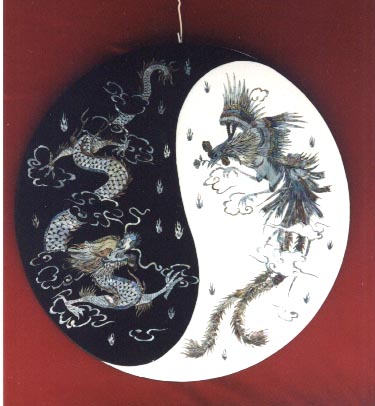
Yin-Yang- The two complementary forces or principles, that make up all aspects and phenomena of life.
"Yin" is conceived from the earth, female, dark, passive and obsorbing, it is present in even numbers, in valleys and streams and is represented by the tiger, the colour orange and a broken line.
"Yang" is conceived the heavens, male, light, active and penetrating. It is present in odd numbers, in mountains and is represented by the dragon, the colour azure and an unbroken line.
The two are both said to proceed from the Supreme Ultimate (T'ai Chi). They interplay on one another (as one increases, the other decreases) being a description of the actual process of the universe. In harmony, the two depicted as the light and dark halves of a circle. The concept of Yin-Yang is associated in Chinese thought with the idea of five elements (Wu Hsing).
Neo-Confucian- Philosophers of the Sung Dynasty (A.D 960-1279) associated Tai-Chi with the concept of "Li" ("principle"); the supreme rational principle of the universe.
Li encompasses Chi(Virtual matter). Transformed through the Yin and Yang cycles of development into the "Five Elements" (wood, earth, fire, metal, water).
Neo-Confucianism- The NeoConfucian philosophy, in the narrow sense is traditionally traced through a line of thinkers, from Chou-Tan-I (1017-73), through Shao- Yung (1011-77), Chung Tsai (1020-77), brothers Ch'eng I (1033-1107) and Ch'eng Hao (1032-85) and finally the great Chu Hsi (1130-1200).
Chou Tan I and Shao-Yung regarded precursors of the Neo-Confucian movement than as its founders, both influenced by modes of thought that had been current in Taoist circles in late T'ang Dynasty and they concentrated on cosmic speculation.
Chang Tsai-Concerned with developing a meta physical system based on the complementary principles of Yin-Yang.
Ch'eng Brothers-Brought the movement to maturity by shifting emphasis from Cosmotology back to human affairs.
Chang Tsai-Concept of Chi (defined litterally as "Air")
Cheng I-Added the concept of Li(reason) to give understanding of both the world and the human mind. The philosophy became known as Li Hsueh (Study of Reason).
Ch'eng Hao-Developed the philosophy with a some what different emphasis, giving rise to the divergent branch of Neo-Confucism known as Hsin Hsueh (Study of Mind).
Chu Hsi-A century later, gave definitive form to the philosophical system. The basic concept of Li(reason).
Li is something inmaterial, immutable and inherent in all things. Gives them form and constitutes their essence. All things posses Li from their first movement of existance and nothing does not have Li. On the other hand Li can exist without things. Thus Li can exist without things but things cannot exist without Li. In the universe their exists an overall Li, which embraces and unites the Li of all things and is called the "T'ai Chi". Simply, "this is the highest of all, beyond which nothing can be". The relation between the T'ai Chi and Li is not that of whole and part.
Li-Constitutes only "a pure empty and vast world, without shape or faces"
Chi-Brings things into existance.
Hence both are necessary in every things existance. Chi bringing the two into being and Li making the thing what it is (the physical nature of a thing eg. man or bird). The Li has become known as human nature that is inherent in the individual. Li for all man is the same, it is the Chi that makes them different (a certain type of quality of man). The Chi in some individuals is clear and they are the excellors, while in some others is cloudy and they are the fools and knaves. On the basiss of this doctrine of Li and Chi, Chu Hsi presents the theory of human nature.
"On one hand, human nature is good because of the Li of humanity can be nothing but good. On the other hand evil exists because of the individuals physical nature or the kind of chi he receives."
The concept of T'ai Chi was underlined in the 11th century by Chou Tun I. Together with Yung, added a strong Taoist strain to the formulation of Neo-Confucism.
Tsai-First spoke of the concept of Chi. Stressing the complete unity of all things. The identification of man, heaven and earth.
In the direct line of Chu Hsi's mentors were the Cheng Brothers. Both made the concepto f Li prominent in their teachings, but also marked a doctorial rift within Neo-Confucism. The concepts at issue are those of Li(principle) and Hsin(mind).
Two Schools
Chu Hsi-(Li Hsuch)-Interpretation of Li and Hsin followed the teachings of Cheng I. His philosophy states "Mind is Li, inherent in things, there is no abstract, Li is eternal"
Lu Chiu-Yuan-(Hsin Hsueh)-Faithful to Ch'eng Hao. His philosophy states "The universe is the mind, the mind is the universe".
The difference is fundamental, Chu Hsi advocated a dualistic system based on the concept of Li and Chi. While Lu Chiu-Yuan advocated a monistic system of the mind, which controlled the universe including the Li.
Taoism and Confucianism
Confucianism is concerned with human society and the social responsibilities of its members. Taoism emphasises nature and what is natural and spontaneous in man. The two traditions "within society" and "beyond society" complement each other and balance.
Taoism- The idea of Yin and Yang. Yin and Yang literally mean "dark side" and "sunny side" of a hill. They are meantioned for the first time in the "Appended Explanations" or the Hsi Tz'u (4th century BC) an appendix to the I Ching.
In the Hsi Tz'u it describes how the one "Promordial Breath" split into the light Yang breath, which formed Heaven. The heavier Yin breath, formed Earth. The diversifications and interactions of Yin and Yang produced the Ten Thousand Beings.
"The warm breath of Yang accumulated to produce fire, the essence of which formed the sun. The cold breath of Yin accumulated to produce water, the essence of which became the moon."
Yin and Yang are often refered to as two breaths or "Chi". Chi means "air" or cosmic energy.
The Primordial Breath
Is a name of the chaos (state of unity) in which the original life force is not yet divided into the phases that the concepts of Yin and Yang describe. Every man has a portion of the primordial life force allotted to them at birth and their task is not to use it up foolishly, but rather strengthen it, control it and increase it in order to live out their full span of life. Another important set of notions associated with the school of Yin-Yang are the "Five Agents" or "phases" or "powers". They being water, fire, wood, metal and earth. They are also "breaths".
Sung Dynasty(960-1279AD)
Founded when Chao K'uang-Yin, the military inspector general of the Chau dynasty. Last of the "Five Dynasties", took control of the empire by coup. Followed Confucion principles; lived modestly.
Five Dynasties
Between the fall of the T'ang(AD907) and the founding of the Sung(960) when five would be dynasties followed on e another in quick succession in North China.
1. Later Liang- Established by rebel leader Chu Wen. Murdered by his own son in 912AD.
2.Later T'ang- Later Liang overthrown by one of its own generals. Li Ts'un-Lsu in 923AD.
3.Later Chin-Later T'ang terminated when one of its generals Shih Ching-T'ang, overthrew his master with the aid of the Khitan, a people from Inner Asia, when Shih Ching-T'angs son attempted to end the tribute payments to the Khitan in 946AD he was taken captive.
4.Later Han-947AD former Later Chin general Liu Chihyuan, pushed the Khitan back into Inner Asia. But his regime only lasted four years.
5. Later Chou-Another general overthrew the thrown. The emperor died leaving an infant son on the thrown. As a result another general, Chao K'uang-Yin seized the thrown, founding the more long-lived "Sung Dynasty, thus bringing the "Five Dynasties" period to an end.
This period was in which printing blocks were developed and the first complete printing of the "Confucian Classics" was developed.
Confucianism
Was the way of life from the 6th to the 5th century BC, followed by the Chinese people for more than two thousand years. Traditionally the substance of learning, a source of values and the social code as well as a religion and a philosophy. Confucianism affected the daily lives of Taoists, Buddhists and Christians alike, until the establishment of the Communist regime.
Confucius lived in an era of political violence and social digration. In China he attracted 3,000 students to his modes of thought and action concerning restoration of harmony and order. In the late Chou period Confucianism became one of the six major philosphical schools, along with Taoism and the school of Yin-Yang.
It was not until the Han Dynasty (206BC-AD220), that Confucionism was adopted by the state as orthodoxy. One of the six classical texts considered important during this period was the I Ching.
Excerpts courtesy ofthe Encyclopedia Brittanica.